Staying true to the original conditions afforded by the classroom, the academy, the gallery, the design modeling workshop, the fashion master class, the group critique, the drawing game, the dinner, or the theatrical setting, the students disclose and draw the contours of their research and pedagogical practices. Each project is drawn together in open forms of negotiation, conviviality and “making public”.

THURSDAY 7 JULY
17:00 — 22:00 OPENING Master of Education in Arts: Graduation Presentation 2016*
19:30 — 19:45 DEMONSTRATION Erica Volpini
20:00 GAME Juan Beladrich & Mariana Fernandes
FRIDAY 8 JULY
14:00 — 19:00 OPEN HOURS GRADUATION PRESENTATION*
15:00 — 16:00 Aspects cards readings Karin Arink
17:00 — 17:15 DEMONSTRATION Erica Volpini
SATURDAY 9 JULY
14:00 — 19:00 OPEN HOURS GRADUATION PRESENTATION*
14:00 — 17:00 Round-Table # 3 Mascha van Zijverden (closed workshop)
SUNDAY 10 JULY
13:00 — 14:30 PICNIC (for faculty, family and friends)
14:00 — 19:00 OPEN HOURS GRADUATION PRESENTATION*
15:00 — 16:00 Aspects cards readings Karin Arink
15:00 — 16:30 GRADUATION Ceremony
(for faculty, family and friends)
Mascha van Zijverden
RECRAFTING CRAFT

Mascha van Zijverden
Recrafting Craft – A synergy of crafts within fashion design education at art schools in the Netherlands
Various crucial aspects have grown more important in today's fashion industry. What are clothes made of? How, where and by whom are they produced? And how can they be disposed? These questions pertain to the design and making of textiles and clothes, as well as to the position and role of crafts in the overall production process. The research project on Recrafting Craft concentrates on the interactions between fashion and advanced fashion education. Where these two worlds intersect, various ongoing changes in the notions of crafts and craftsmanship arise.
Karin Arink
Mapping AUTONOOM Voices

Karin Arink
Mapping AUTONOOM Voices
The definition of what art — and of what an artist — is, has become more and more discursive and circular. Myths of 'the artist' obscure what contemporary artistic practices possibly can be. The discussion of the legitimacy of art education forms lead by artists, theorists and art educators worldwide is only multiplying. So how do we — art educators in higher education BA Fine Arts — teach art?
Juan Beladrich
Group Critique

Juan Beladrich
Group Critique — Facilitating an alternative framework
With my research I am proposing an alternative space for art education at the Willem de Kooning Academy. Using Group Critiques as method, I experimented with creating a space where art education can change its focus from a more traditional object-based approach, to placing the focal point on the students themselves in order to empower them. This way the students will gain the necessary tools to learn and grow in their own way.
Clare Breen
Breadfellows' Chats

Clare Breen
Breadfellows’ Chats
My thesis and education project develop and use a methodology for bringing an artist's practice to the centre of a gallery based education programme. With conversation at the core, my methodology focuses on artists' practices in order to extend that practice at the point of exhibition through co-constructive workshops with the public.
Mariana Fernandes
The possibilities of integrating queer pedagogy in fine art curricula

Mariana Fernandes
The possibilities of integrating queer pedagogy in fine art curricula
This master thesis explores the possibilities of integrating queer pedagogy in the first year of a fine art curriculum, specifically the impact it can have on informing the students' social and artistic identities. I address fine art mostly from a perspective that focuses on the students' self-development at an intellectual level, reflecting in its turn on their personal and artistic growth and maturity. Furthermore, I explore modes through which education can facilitate frameworks for individuals to build their intellect and personality by informed choices and not through presumed parameters that constrain individuals to non-negotiable positions.
Rick Fingal
Theatre as dialogue for exploring student agency

Rick Fingal
Theatre as dialogue for exploring student agency
Where do students of pedagogical and social work — who are expected in the future to be able to restore, stimulate and maintain the agentic behaviour of their clients — experience and locate their own agency as meaningful?
Sita de Kam
What do your head, hands and heart tell you?

Sita de Kam
What do your head, hands and heart tell you? Towards an actualization of the Waldorf art curriculum on the basis of it’s primary principles
My research focuses on the renewal of the art curriculum of the so-called Waldorf education. In order to do so, I re-examined its content by studying the theory underlying Walfdorf education, the principles of artistic research, Gert Biesta's view on education and close reading the work of the founder of Waldorf education: Rudolf Steiner. For me this study had two major purposes: firstly to build further on this research by developing an education project for the Waldorf teacher training programme, providing them tangible suggestions to renew their lesson content. And secondly, to provide a new view on the traditional materials used within the Waldorf arts and craft curriculum.
Katinka van der Laan
Picture this

Katinka van der Laan
Picture this
I have taught art for twenty-one years; a period in which I witnessed the rise of the current media society. In the current digital world it has become impossible to imagine modern life without the Internet and digital tools. Nevertheless, this digital world still seems to be largely absent in the current art curriculum in secondary education.
Annelies de Leede
The power of making

Annelies de Leede
The power of making. The physical model as a design tool for product design students
In the practice of product designers the computer has become an indispensable tool. Before the introduction of the computer, the design process was closely connected to the process of making. Since the mid-1990s, digital technology has slowly but steadily changed the field, resulting in a changing role for physical models. Many students tend to see the computer as the most important tool in all stages of the design process.
Erica Volpini
Discovering an outsider

Erica Volpini
Discovering an outsider
As a graphic designer and illustrator I was asked, a few years ago, to give guest workshops in a pre-school in Italy, guiding the children to make illustrations for books. This experience highlighted some aspects of how drawing activities are conducted and perceived already in the early stage of three to six year old children, both by teachers and children. The visual language, which is seen as a fundamental expressive tool for children, is often reduced in its powers by the teacher's recommendations and ways of pointing out what is "right" or "wrong", or by the attention to the outcomes more than to the processes.
How to act otherwise? – is the central question of this presentation collectively made by seven graduates of the Master Education in Arts of the Piet Zwart Institute. Seven concepts are proposed, each hosted by one student as a lens to highlight an aspect of their graduation project and to open this up to wider issues in arts education. The seven concepts are organized as a constellation, interwoven by cross-references to elements of each other’s projects.

Graduation Presentation 2017
Act Otherwise – Event program
Location: V2_Institute for Unstable Media, Eendrachtstraat 10.
Time: 13.00 – 17.00
13.00 – 13.45: Collective Movement by Ilse Leenders
Wandering Flock – a Bodily Exercise in Unison
Number of participants: open (+/- 25 participants).
This performance starts inside but will take place in public space.
The Wandering Flock is a bodily exercise in unison, inspired by the flocking of birds. In this workshop everybody actively participates mimicking the flocking movements in an outside location. The experience invites to explore and become aware of bodily senses, while focusing on the other and the surroundings. Each individual can take the position of leader and change the direction of the group, while communicating in a non-verbal way. The exercise aims for a more inclusive way of learning where a coherent connection between body and mind is present, while learning through the collective. For the development of the method Ilse Leenders follows among others, concepts of Japanese arts derived from Shinto and Zen Buddhist philosophies and experiential learning as taught in Black Mountain College and Forest Schools. By participating in the workshop the method can be physically perceived and understood.
14.00 – 14.45: Collective Drawing by Sebastian Schneiders
Point, Line, Space, Time, Me, You, Us
Number of participants: +/- 20
Beyond seeing, drawing is a material and haptic activity. In this collaborative drawing workshop participants explore and question what we can do with lines (and what lines can do with us). If a drawn line is the trace of a movement; in what ways can it be enacted as it moves from point, to line, to defining space and moving through time? What can a line learn and what stories can it tell? A line can mark a border or trace a path. How far will we deviate, and what does it mean to draw together? An hour to explore and reflect on the ‘point on a walk’.
14.45 – 15.00: Short Break
15.00 – 15.45: Workshop by Annemarie Piscaer
GO TO THE MOON AND BACK
Number of participants: max. of 15 participants
We will go in an imaginable trip to the moon and back. The moon provides a canvas to ‘unlearn’ by deconstructing embedded professional knowledge and routines, and by reflecting on earth. This is relevant in order to deal with ecological issues. We can only understand the new if we unlearned everything we’ve accepted and learned. ‘The frontiers of science are such that almost every morning many of our hypotheses of yesterday are found inadequate or in error. (…) If a capable student wants to become a front-frank scientist he has to be able to unlearn everything he has learned.’ (Buckminster Fuller, 1962)
16.00 – 17.00: Lecture Performance by Shailoh Phillips
Some Troubles with Making: Critical Tools for Futurecrafting in the Age of Entanglement
Number of participants: open
‘Making’ is one of the latest buzzwords in education. It is a highly malleable a container term that travels between different disciplines in art, design, and engineering. Makerspaces carry quite a load of utopian promises: opening up technology, bringing (power) tools to the people, bridging the digital and the analogue, preparing the next generation for the future—nothing short of the next industrial revolution, with an emancipatory impulse to match it. But is this a real revolution, or just a new phase of capitalism, bringing new mechanisms of control and exploitation, new ways of distracting and alienating people? Shailoh Phillips will explore the potential of tentacular pedagogy for digital crafts, based on 6 months as an embedded researcher at Bouwkeet Makerspace. This lecture is packed with practical examples and fundamental questions that come from the nitty-gritty of beginner’s lessons in 3D printing, sewing, digital crafts, 3D printing, welding, woodworking, ceramics etc. She maps the affordances and the constraints that open up in the microcosmos of the Maker Movement, in relation to the underlying ‘wicked problems’ in society. Without deliberate strategies of resistance, it is quite likely to get stuck in a loop of producing and reproducing power structures, instead of nurturing empowerment. Getting out of this mess requires an updated understanding of tools and technology, of teaching and learning, rethinking what it means to “make” something that matters.
Marina Martinez Garcia
Towards Ecosophical Action Design

Marina Martinez Garcia
Towards Ecosophical Action Design: Building Blocks for a New Awareness in Design Education
This study is an investigation into design education and praxis. It calls for an ecological awareness built upon the principles of ecosophy formulated by Felix Guattari in his The Three Ecologies (1989): namely, social, mental and environmental ecology. The rationale for this research is based upon my observations and concerns as a designer and educator that existing design education and praxis largely lack awareness of their ecological implications.
Janneke Baken
We Care a Lot

Janneke Baken
We Care a Lot: A Theoretical and Practical Exploration of Exhibition-making with Students
My thesis is about creating a lesson structure for making an exhibition together with students, because this can lead to a meaningful educational experience. In my opinion, visual art education is unnecessarily individualistic and isolated, and exhibition-making can bring about a change here. Cooperation is an essential part of exhibition-making, which involves a common goal that each student can shape in his or her unique way.
Sebastian Schneiders
Drawing to learn

Sebastian Schneiders
Drawing to learn: Encouraging the explorative and dialogic potential of sketching in design education.
Throughout the history of art and design, the practice of drawing has served as a way to explore, test and communicate visual and spatial concepts. In particular, the sketch has been valued for an indeterminacy that allows multiple design paths to stay open for reinterpretations, adjustments and new insights. This unfinished quality positions the sketch in an explorative and dialogical mode, a mode of visual research rather than just being an end-station. Beyond drawing skills, what is at stake in design education is whether a student’s drawing practice becomes embedded in attitudes and motivations suitable to the explorative and dialogic nature of creative practices. Learning conditions should encourage students to explore a range of methods in personal and meaningful ways.
Shailoh Phillips
Some Troubles with Making

Shailoh Phillips
Some Troubles with Making Tentacular Pedagogy in the Age of Entanglement: A Toolkit for Bouwkeet
‘Making’ is one of the latest buzzwords in education. It is a highly malleable ‘container’ term that travels between different disciplines in art, design and engineering. Makerspaces carry quite a load of utopian promises: opening up technology, bringing (power) tools to the people, bridging the digital and the analogue, preparing the next generation for the future – nothing short of a fourth industrial revolution, with an emancipatory impulse to match. But is this a real revolution, or just a new phase of capitalism, bringing new mechanisms of control and exploitation, new ways of distracting and alienating people?
Ilse Leenders
Wandering Flock

Ilse Leenders
Wandering Flock: A Bodily Exercise in Unison
My experience in higher art education seems to suggest that there is an over-emphasis on mental abilities, like learning to verbalize, contemplate and conceptualize one’s actions. In contrast, therefore, I have developed a physical exercise emphasizing the senses to balance the attention between mind and body. The Wandering Flock: A Bodily Exercise in Unison aims to create a balance between the body and the mind while the individual is learning through a collective activity.
Annemarie Piscaer
As a Designer, I’m an Expert, I’m an Amateur

Annemarie Piscaer
As a Designer, I’m an Expert, I’m an Amateur: Operating on the Fluid Boundaries of the Design Profession
Living as we do in the Anthropocene, we are facing climate change and global inequality. These ecological issues require inclusive, transdisciplinary collaborative efforts. A city lab, where all of the participants are experts and amateurs at the same time, provides a 'safe' ground for experimentation and the development of new knowledge. City labs are recent phenomena where ‘the city’ is used as a ‘canvas of reality’ for collaboration between various experts, designers and local citizens. Designers take on different roles in these transdisciplinary design practices and have an essential function within these new lab settings.
Robin Vermeulen
Contested Exchange

Robin Vermeulen
Contested Exchange: A Practice-based Exploration of Museum Learning Communities
Over the years, there has been a rising interest in the concept of the learning community in education departments in contemporary art museums and galleries. This development can be attributed to changes on a political as well as institutional level in Europe as well as the US. The change of art policy has meant more funding for community-centred art education projects, while institutional developments have increased the interest in and opportunities for democratically-oriented, critical education in the museum and art world.
The Master Education in Arts presents the work of its students using two formats: the symposium 'Pedagogy in Context' hosted by TENT., and a Reading Room at the WdKA. The symposium consists of workshops, performances, presentations and discussions. It introduces the contexts and methodologies of the students’ projects and invites visitors to participate in an open discussion on the urgencies of contemporary art/design education. The Reading Room offers a space to access the ‘living archives’ of the students' theoretical and practice-based research.

Master Education in Arts – Graduation Presentation 2018
Pedagogy in Context
Friday & Saturday July 6 – 7: Symposium Pedagogy in Context,
TENT. (live screened in the Reading Room).
TENT., Auditorium, Witte de With straat 50.
July 6: 11.00 – 20.00 hrs (drinks afterwards)
July 7: 11.00 – 17.00 hrs
July 5 – 8: Reading Room,
WdKA, Piet Zwart Institute, 4thfloor, Wijnhaven 61.
Opening 5 July: 17.00 – 23.00 hrs
July 4 – 6: 11.00 – 23.00 hrs
July 7 – 8: 11.00 – 18.00 hrs
Marianne van Horssen
Imagine Others: Creating a Personal Landscape

Marianne van Horssen
Imagine Others: Creating a Personal Landscape
This master thesis explores how performative reflection can be used in secondary school art education to create a studio project that reflects on social cultural themes. In contemporary art education, assignments that are set in social cultural contexts and connect with the students’ lived world or that use the class as a learning environment are rare, as are assignments which focus on performative reflection as a way to express feelings.
Fieke Dieleman
More Than a Shared Experience

Fieke Dieleman
More Than a Shared Experience. Intergenerational Learning in the Art Museum
This research discusses intergenerational learning for families in an art museum. As a museum educator with a professional and personal interest in family learning in the museum, I noticed an increase in educational programmes in museums designed specifically for families. This research shows how this kind of family activity can become a new learning experience, when it is designed to encourage intergenerational learning; in other words, mutual learning between generations.
Felix Dorer
Spooks and how to exorcize them

Felix Dorer
Spooks and how to exorcize them
There is something strange in the back of my mind. My pen hovers above the paper. The clock ticks away. There was something I wanted to say. But my words don’t seem to come out.
“Forced. Cannot produce. Nothing to write. Concentrate. Slow. Not enough. Short. Write. Why. What. No sense. Not concrete.”
There is nothing useful here. Where did it go?
“Spooks and how to exorcise them” is a practice-based research about inhibitors to the creative process in the Creative Writing class: How to find them, why they might occur and what we can do to overcome or prevent them.
Quirijn Menken
Constellating images: Bilderatlases as a tool to develop criticality towards visual culture

Quirijn Menken
Constellating images
We live in a predominantly visual era. Vastly expanded quantities of imagery influence us on a daily basis, in contrast to earlier days where the textual prevailed. People no longer document their lives with diaries or letters. The increasing producing and reproducing of images continuously compete for our attention. If so, can we speak of an expanding visual culture? If there is an increasing production of images, does this mean that other cultural products, like first-hand experiences, are being superseded?
This research questions if a Bilderatlas as an alternative tool in art education might help students to become critically towards their dominant visual culture.
Susana Carvalho
Counterspace

Susana Carvalho
Counterspace: Classroom space as a pedagogic tool to share authority and to empower (design) students.
This research investigates the potential of space as a pedagogic tool, especially in the graphic design classroom. Within this context, ‘space’ should be understood not only as the physical space of the classroom but instead as a broad and overarching concept: the space within typography, the space one occupies, the space of the institution, or the social and political spaces that emerge through daily interaction.
Acknowledging that space is never neutral, I question the institutionalised and normative behaviours in the classroom and higher education by subversive my position as a teacher. How can we change this rigid perception and experience of space? I propose a multi-definition of space as a lens to my theoretical and practical investigation: Open Space, Informal Space and Other Space. These open new possibilities for interaction within the classroom and new ways to relate to authority. A strategy to empower students in their position and hopefully bring these alternative ways of behaving also outside the classroom.
Emily Huurdeman
Essaying Art

Emily Huurdeman
Essaying Art: An Unmethodological Method for Artistic Research
This research is about education in artistic research. Artistic research is a relatively new field in which academic research and artistic practice are integrated. It encapsulates a vast variety and combination of academic and artistic fields, topics and disciplines. Defining this institutionalised field, and the methods and criteria for evaluating its output, is the subject of much debate. Because scientific and artistic methodologies are subject to different criteria, there’s no one universal definition or evaluation in this educational field. Science needs to articulate its sources, as well as its relevance and its context, and it must provide clear argumentation, whereas art is not constrained by these demands. Can we integrate the scientific and the artistic in individual working methods?
Amy Pickles
[sic] scripture
![[sic] scripture](https://meia.wdka.nl/backend/wp-content/uploads/2018/06/25-copy-1.jpg)
Amy Pickles
[sic] scripture: How to Use Scripts to Imagine Counterdiscourses?
[sic] scripture is an investigation into modes of reading, writing, speaking and listening to scripted texts. The intention: situations where you encounter different identities and perform the ambiguity of not knowing. Through performing, I have come to understand that I am trying to find ways to reach a polyvocal position – polyvocality performed alone, my identity shifts in research and writing; and performed in groups, in workshop scenarios.
Desiree Kerklaan
Collecting For User Stories

Desiree Kerklaan
Collecting For User Stories User-Centred Research in Higher Art and Design Education in the Netherlands
The research theme for my graduation project, Collecting For User Stories, has been inspired by conversations with students at the Willem de Kooning Academy (WdKA), where I teach Research & Design. In these conversations, the students expressed difficulties in formulating the urgency of a design. After observing students working on several (social) design projects, it became clear this seems to be associated with a gap between the design students’ own commitment to a project, and the needs of the purported user of the project. This led to the subject of this research: how to teach user-centred design.
Viki Zioga
ΦΑΝΤΟΜ Power

Viki Zioga
ΦΑΝΤΟΜ Power: Developing a Collective Listening Consciousness through Artistic and Pedagogical Strategies
The unfair conditions of audibility in our society, which consequently affect individual and collective agency, point towards the urgency of a listening literacy on a macro- and micro-political level. Hence, we need to begin in our immediate environments and transform them into communities of conscious listeners. This research project investigates ideas for the transformation of listening. How can we weave artistic strategies and pedagogical methods into a learning structure that facilitates the development of a collective listening consciousness on a micro-political scale?
Maarten de Vugt
Teaching Pupils in a Digital Visual World

Maarten de Vugt
Teaching Pupils in a Digital Visual World
Because of how easy it is to use smartphones and tablets nowadays, everyone who owns a mobile smart device is able to work with creative applications. It just takes a click or a swipe to create a visual and catapult it into the world for everyone to see it. This global, technological presence of images, the ease and speed with which they can be produced and reproduced, and the power of their pervasiveness, demand serious attention in education. Therefore, the purpose of this research is to show how contemporary visuals made by students on smart mobile devices can be used as an aid in developing a critical attitude in art class.
Welcome. Feel free to engage or just observe.
Take a seat, walk around, talk to us.
Listen to our presentations, join our discussions.
Have something to eat.
We are the class of 2019 and this is Pedagogy of Insist_ence.
A safe space, a learning space, an ‘other’ space.
Where going against the grain is something we believe in, even though it leaves its marks.
Where we push through our own discomfort and where we invite you to be uncomfortable with us.

Master of Education in Arts – Graduation Presentation 2019
Pedagogy of Insist_ence Symposium
Saturday 13 July
11.00 Doors open
11.10 Performative opening ceremony by the students
11.30-12.10 Lecture-performance by Marjolijn van den Berg
Open (Up) Writing
A lack of insight into the writing process and not knowing how to overcome writing obstacles can make art and design students feel like writing is inherently difficult and ‘just not for them’. But then how do you make them comfortable with writing then? In this performance lecture we look at how to get students on board with writing by implementing strategies from creative and artistic writing.
12.10-12.50 Joint presentation by Mona Dekker and Andre Hasan
De-economizing the Present / De-economizing the Future
A duo presentation by Mona Dekker and Andre Hasan of their educational projects which are part of the first year of the Associate Degree Arts & Crafts, a two-year higher education course in design. The projects involve the questioning of how students can react to currently changing conditions through design.
12.50-13.40 Lunch (we invite everybody to stay for lunch)
13.40-14.10 Interactive presentation by Jan Siebers
How Designers Think
Ten Ways of Thinking in Convergence for Design Education
14.10-14.40 Performance by Darly Benneker
14.40-14.50 Q&A
A Subtle Gesture of Sewing – An Intimate Performance on Life Story Narrating through Textiles in Art Education
The performance addresses the gesture of sewing as a metaphor to discuss the project Clothed Bodies. What new stories can we weave together? Considering the notion of an expected story in public space, the acts of collectively sewing, creating new dialogues based on the multiplicity of life stories.
14.50-15.10 Break: snacks
15.10-15.50 Dialogue between Ariadne Urlus and Jip van der Hek
Kunstlab: a Children’s Territory
Kunstlab is a ‘free space’ developed by the artists of SKARlokaal De Toermalijn for children from the Zuidwijk neighbourhood (Rotterdam South). Kunstlab is thought of as a children’s territory. Kunstlab strives for ownership for the participating children; the artists’ different (professional) practices and approaches inspire and give direction to working in the studio. The dialogue will zoom in on the complexity of this endeavour.
15.50-16.30 Beyond Making Stuff_Thinking through Making In_Disruption – a Tactical Pedagogy
A performance in four plus one movements by Mark Shillitoe
This performance addresses disruptions and glitches in education, taking the position of ‘making’ as an environment for critical inquiry. Situated in a post-digital space, In_Disruption proposes a collection of field tactics which seek to explore a relationship between thinking and making. Collectively, the tactics find moments to look and listen for these ruptures. To act within the rhythms, patterns and systems of learning, and the institutions they inhabit; guided by a process of making and remaking curriculum and learning.
16.30-17.00 Closure & drinks
17.00-19.00 Master Education in Arts Graduation Ceremony (private)
Ariadne Urlus
SKARlokaal as an Alternative Learning Space

Ariadne Urlus
SKARlokaal as an Alternative Learning Space
My research focuses on SKARlokaal, of which I am one of the initiators. SKARlokaal is a concept based on a form of ‘embedded artistry’: artists occupy a studio (rent it through SKAR, Stichting Art Accommodation Rotterdam, hence the name) in or near a school and from there start a relation with this school and its surroundings. As a pilot, SKARlokaal has been in operation for about two years at the former (vacant) kindergarten pavilion of De Toermalijn primary school in Zuidwijk, a neighbourhood in the southern part of Rotterdam.
Jan Siebers
How Designers Think

Jan Siebers
How Designers Think _Ten Ways of Thinking in Convergence for Design Education
Convergence is the phase in the design process following divergence. Divergence, in the design context, mainly relates to the generation of ideas and the broadening of possibilities. Although convergence is necessary in order to make choices and move towards the more specific, there is a lack of real insight into the process of convergence. This thesis aims to gain insight into the thought processes surrounding convergence in order to identify a stronger basis for design education. The main question of this research is therefore: ‘What is ‘converging’ in design education?’
Mark Shillitoe
Beyond Making Stuff_Thinking Through Making

Mark Shillitoe
Beyond Making Stuff_Thinking Through Making
The idea of the educator as a critical maker of learning and curriculum, referred to in my graduation research project, underpins my ambition to challenge and transform pedagogical learning environments into spaces of possibility by means of embodied making practices which open seemingly invisible structures and networks within a school.
Andre Hasan
De-economizing the Present

Andre Hasan
De-economizing the Present
The programme for which I teach is the Associate Degree Arts & Crafts, a level of higher design education that can be achieved within two years. The incoming students are graduates of a broad range of creative secondary vocational education programmes; they have been provided with basic (e.g. reproductive) professional qualifications in job categories related to trade, craft, or technique and have gone through a solid training oriented to practice and skills. The implication is that this type of student somehow lacks the ability to (re)act, to criticize and to resolve autonomously. Moving these students forward in their autonomous artistic and knowledge development is the main challenge which Associate Degree educators must face.
Mona Dekker
Trans-Realist Design

Mona Dekker
Trans-Realist Design
This research project examines the potential of a pedagogical space for getting design students to focus on ‘the problem of the future’. Its central question is how ‘trans-realist design’ – the act of making the future tangible and bringing it into today’s reality – can create a new attitude that is concerned with opening up multiple potentials for the future.
Marjolijn van den Berg
Open (Up) Writing

Marjolijn van den Berg
Open (Up) Writing
Look over there. Do you see that group of students, looking at their feet, sighing by turns? They have just been told that they need to write a self-reflective document.
‘I can’t believe we need to do this.’
‘I know man; we are not going to learn anything from this.’
‘Writing is not just “challenging”, it’s oppositional to making art,’ replies another.
They nod their heads in agreement. When the teacher says it’s time to start the class, they shuffle in, their bodies tense with reluctance.
Darly Benneker
Clothed Bodies
Darly Benneker
Clothed Bodies – What new story can we weave together?
We human beings are extremely good at conforming to what is expected of us when systems and ideas are imposed upon us. We therefore reconstruct the narratives of our personal lives so that our stories resemble the expected, singular story. But when and where can we truly be ourselves? To what extent is free expression accepted in public space, and how does this affect the human gaze?
Cyrille Montulet
Exposed
Cyrille Montulet
Exposed
I began my study in the Master of Education in Arts programme with the intention of learning more about the strengths and weaknesses of subjective storytelling in video journalism, and how I might implement this research in my role as a video trainer in the future. I have worked for years in the international field as a video trainer, and have witnessed young people who were very eager to become video journalists so that they could cover stories about their own community and environment and use it as a tool to advocate for their human rights. However, the media landscape and media news consumption have changed incredibly over the last decade and I wondered if my personal motivation and passion for video journalism was still appropriate for the contemporary situation. I therefore asked myself: Are my personal and professional ethical values still pertinent for teaching future video journalists, or might they hinder me?
Lydia Burgess
Constructing Collaboration
Lydia Burgess
Constructing Collaboration
School environments that epitomise a confined and spoon-fed approach to learning can leave students with little room for a voice. In this study, I aim to provide an environment that values an alternative approach: fellow teachers and students (aged 6-11) use a Makerspace at an international primary school as a premise for greater student agency.
Elvira Vroomen
The Missing Ingredient
Elvira Vroomen
The Missing Ingredient
In my work as a visual education teacher, I often look for ways in which pupils can express themselves through art and share this with a classmate or group. An experience at a school camp made me interested in the interactions between pupils, their learning environment and food, or the act of eating. This event included a series of creative elements such as devising a recipe and preparing and presenting a dish. The research question this led to was: How could these interactions be incorporated into an art class? What do you need to design a performative meal with a group? How can engaging with food contribute to an artistic programme in secondary education and promote connections between the context in the classroom and outside of it?
Caro Kroon
Mean Girls vs VSCO Girls
Caro Kroon
Mean Girls vs VSCO Girls
In 2016, I was invited to go to Gobabis, Namibia on a working visit as an independent artist and theatre-maker for the first time. I had thought it would involve a one-off theatre performance with and for the school children there, but in the meantime, at the request of the Governor of Gobabis, I have been working for 4 years on setting up a pilot project for an after-school arts and theatre programme for the children who live in Epako, the adjacent slum.
Adam Patterson
[REDACTED] shorelines
![[REDACTED] shorelines](https://meia.wdka.nl/backend/wp-content/uploads/2020/08/samcastle.jpg)
Adam Patterson
[REDACTED] shorelines
Crisis is ongoing, layered and sticky. And it isn’t coherent. Neither is this text. Shorelines form, shorelines disintegrate. What began as a dissatisfaction with current vocabularies regarding identity and a hunger for more meaningful ways of accounting for the complicated nature of our bodies and experiences would be subjected to further complication through crisis after crisis after crisis. Trying to account for the complexities of bodies otherwise unaccounted for, bodies queered by crisis, bodies deemed invisible, dispensable or ungrievable, bodies confronted with the very real material conditions of a world not built for their survival, [REDACTED] shorelines is a shattered text taking the time to grieve and elegise the experiences of these bodies when there is no time to be taken.
Robert-Paul Wolters
What if the student were a crown?

Robert-Paul Wolters
What if the student were a crown?
As an art teacher in secondary education, I used to work with students who had little motivation for the subject of Art & Design. Until a few years ago my classes were rather directive and teacher-driven, with a freedom that can best be defined as 'directed freedom' and that certainly did not always contribute to the students' involvement or motivation.
Marijke Appelman
A Pedagogy-in-Process

Marijke Appelman
A Pedagogy-in-Process: The artist teacher in the feminist classroom
This research project aims to reflect on my pedagogical approach and my role as an artist-teacher working at the Willem de Kooning Academy in Rotterdam (the Netherlands), a position in which I teach from my own artistic perspective, bringing multiple experiences as a self-employed artist to the classroom. The research became qualitative and active through what I call experimental exchanges in the feminist classroom, based on four pillars that intersect: Voice, Collaboration, Positioning and Archive.
Rob Wieringa
Exploring Resources for Creative Self-Confidence of Vocational Media Design Students

Rob Wieringa
Exploring Resources for Creative Self-Confidence of Vocational Media Design Students
The design process is inherently experimental, and so in essence it has no predictable result. However, the vocational Media Design students that I teach are from the outset very much accustomed to having to adhere to precise goals in their performance. As these concerns are opposite, the students experience tension. They regard creativity as a sudden, ‘mystical’ occurrence. It is difficult for students to know that their performance will be assessed on the basis of something that doesn’t seem to be in the realm of control. At the same time, many students think they need to instantly and constantly be original. Under such pressure, they often find it difficult to engage in a fruitful design process.
The class of 2021 spent a significant part of their study during the COVID-crisis. This made them increasingly aware of physical presence as a meaningful aspect of education, as well as of an urgency to devote themselves to a collective decision-making process in preparing their research and presentation. While the radical proposal of a collective graduation project didn’t fall through, alternatively, they started searching and probing to share a digital binder and publication: preparations for being together in an unknown period of time.
http://meia-graduation2021.pzwart.nl

Márton Kabai
Through the Wounds of Design, We May Find Each Other
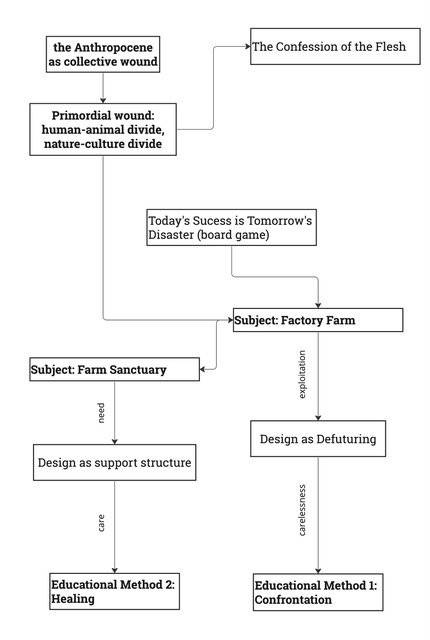
Márton Kabai
Through the Wounds of Design, We May Find Each Other
“Through the Wounds of Design, We May Find Each Other is an educational research project outlining a Wound-Centered Educational Design through the reflection and evaluation of the study year (during Covid19) 2020-2021 elective module Designing Our Ways Out of Design (DOWOD) at the Master Institute of Visual Cultures (MIVC) located in Den Bosch. I argue for a reconfiguration of design away from itself, away from the centrality of the human, through ontological design, post-anthropocentrism, affirmative ethics, and post-critical pedagogy. I outline a Wound-Centered Educational Design that centers around the wound metaphor, locating the human-animal divide as the primary wound of the Anthropocene condition. I explore two ontological designs that center farm animals in opposite ways: industrial factory farms and farm animal sanctuaries. Based on these subjects, this thesis will elaborate on two main methods, confrontation, and healing, in which I evaluate my educational practice. Overall, design education needs both a critical understanding of the violent world (confrontation) and an empowering, generative, collective space and practices to care for the needs that emerge from these wounds. “
Lisanne Janssen
What I Have Been Meaning to Tell You

Lisanne Janssen
What I Have Been Meaning to Tell You
What I Have Been Meaning to Tell You is a collection of short texts, essays and letters in which I try to articulate a working educational ethos that is ‘lived’ rather than ‘fossilized’. I inquire if and how being attentive, tending to, can be a ‘gripping tale’ to tell. How can I honour and articulate what often goes unnoticed?
Marjolijn Gunst
It´s More Like Playing

Marjolijn Gunst
It´s More Like Playing
“But your classes aren’t real classes, right?” Rayaan responded after I told the children that I would write a small report about their progress. I had been teaching theatre at the school for a few years now and we were near the end of their theatre curriculum. I asked the group what they thought a real class meant. “Something where you learn stuff, about history or math or spelling,” Rayaan replied. His reaction did not surprise me, but I could not resist asking carefully: “So you don’t learn anything during these classes?” The children thought about it and it was Rayaan who raised his voice again. “We do learn stuff. But it is different, you know, it’s more like playing.” The others nodded their heads and the room was quiet for a while. Then Romaissa burst out: “All right, can we start now?”
Annemarie van den Berg
How to Teach Like a Pony

Annemarie van den Berg
How to Teach Like a Pony – About a pedagogy in the middle and ongoing adventures ‘of making-with’
Looking back at my practical experience with the designers’ collective Pink Pony Express, I try to analyse our way of working to see how this can be of meaning within my teaching practice. Pink Pony Express works at the interface of research, design and society. Site-specific research and making are the core principles of their practice, which rely on situationally defined notions of mutuality, reciprocity and relevance.
Maud Berden
The Art of Reproductive Labour

Maud Berden
The Art of Reproductive Labour
My experience as a volunteer and later an intern at Niffo Gallery / Recycle Studio – a gallery with a societal and educational function for the Afrikaanderwijk in Rotterdam – sparked my interest in the worth commonly ascribed to ‘reproductive’ tasks such as cleaning, grocery shopping and welcoming visitors in the cultural, care and service sectors. It made me wonder how MBO care and service interns look at and value such tasks. What does it mean for them to be trained in and assessed on everyday labour that is invisible and undervalued?
Gundega Melberga
Intimate Museum

Gundega Melberga
Intimate Museum
This body of research explores somatic and embodied forms of engagement through sound. What originated as the appropriation of institutional critique and began as an attempt to practice more accessible art interpretation by means of sensory-based experiences in a museum setting, evolved in light of the Covid crisis into an intimate exploration of one’s own body and being. Due to restrictions imposed by the pandemic, my methods of inquiry were intimate and the scale of my project was very small: only friends and classmates partook in it. As a result, this research not only became an exploration of the medium of sound, but also a record of my own personal journey as a practitioner moving away from formal museum education towards a more hybrid and intimate form of interaction with a small public.
Diogo Rinaldi
Offfence – an exploration in horizontality and co-responsibility

Diogo Rinaldi
Offfence – an exploration in horizontality and co-responsibility
‘Offfence’ was a collaborative experiment with the objective of creating an alternative educational program in Matera, Italy, as part of the Collective Minor semester of the bachelor’s curriculum at the Design Academy Eindhoven. Students reacted to the unaddressed conflicts and often-unhealthy hierarchies at the academy by engaging in a horizontal alternative for an educational process.
Having taken part in this experiment both as a mentor and as a participant, I analyse it in hindsight by taking a comprehensive look at the project’s archive, publications, my personal notes and informal conversations with former participants. The focal points of this research are horizontality and co-responsibility as core qualities in engaging in a shared creation of meaning.
Anita Hrnić
Choreographing the Liminal

Anita Hrnić
Choreographing the Liminal
In 2020, people all over the world entered a new era of uncertainty. The global pandemic disrupted societal structures, resulting in a reassessment of priorities. While many, feeling anxious and paralyzed, expressed the urge to ‘return to normal’, there was also a growing realization that this disruption offered the potential for change on both the personal and societal levels.
That same anxiety was present in many of our collective classes during the MEiA Master programme. It became challenging to speculate on and consolidate research arguments in a context that was no longer fixed, where education looked and felt different than before the lockdown. The uncertain space in which one finds oneself in such situations is the liminal space. It often emerges when an unfamiliar element disturbs the existing conditions, and one is forced to make sense of how to proceed from there. The term stems from anthropology, denoting a transitory, disorienting space in which participants in a rite of passage transition from one mode of being to another. This phenomenon occurs when an old system no longer functions, but a new system has not yet been formed. It is a moment when change is possible, when creativity and progress can thrive.
Through participatory workshops, open space discussions and performative exercises, Rehearsal: Emerging Learning Sites introduces the diverse contexts and methodologies the class of 2022 was working with. Rather than reporting on their findings, the students engage in a conversation with all those passionate and/or curious about contemporary institutional and alternative, experimental education.

Huy Bang Phan
The Hidden Potential. How can we cultivate and harness hidden potential in vocational art students to expand their personal agency?

Huy Bang Phan
The Hidden Potential
While traditional knowledge in education is valuable for its wisdom, looking at other fields widens the perspective and adds depth to the existing knowledge. This research shows that education can gather methods from gamification to benefit both students and teachers.
Gamification masters the technique of getting the most out of players; using this in education means getting the most out of a student. Gamification reduces education's complexity into two simple groups: positive motivation and negative motivation. This simple method makes it possible for teachers to analyze and design their lessons in a strategic way to find the hidden potential beyond what we can see.
Elina Charinti
Holding Moments. Understanding and Engaging Affective Pedagogies with Emergent Multilingual Children

Elina Charinti
Holding Moments
This research is an attempt to learn how to build more respectful interactions and relationships while working with emergent multilingual children at the asylum seeker’s centre in Rijswijk. My interest in this research started with the will to investigate ways to overcome language barriers when working in spaces with children where a multiplicity of languages is spoken and where we many times were lacking a common language to communicate in. I felt that language was often an issue, a boundary, causing a lack of engagement, miscommunication, frustration, limited connection, disempowerment. Observing these effects made me willing to develop practices which are beneficial for situations when we may be experiencing linguistic limitations and overcome language challenges and other boundaries.
Urtė Baranauskaitė
(In)dependent student-led communities as spaces for undiscovered opportunities for relations, collaboration and connection

Urtė Baranauskaitė
(In)dependent student-led communities as spaces for undiscovered opportunities for relations, collaboration and connection
In her research, Urtė Baranauskaitė explores the potential of (in)dependent student communities and their ability to facilitate new, unexplored opportunities for interaction, learning, collaboration and building relationships. The research is focused on the process of community-building, sustainability and is centred on Urtė's experience as a member of Archipelago, a student-led community for Master students from the Piet Zwart Institute.
Kasia Dembinksi
Conducting coincidence

Kasia Dembinksi
Conducting coincidence. The art studio as a space of suspension.
This research examines how to cultivate conditions for artists in education to develop a studio practice by creating or recognising a suspended space. I see the need to encourage ambiguity and spontaneity in art education, for students to become unburdened by the weight of expectation and outcome-focused work during their time in education and thereafter. Consequently, my intention has been to encourage students to develop their intuition and independence in making art, by participating in process-led learning in a studio environment. Fundamental to this research is recognising what a studio is, both in and outside an institution and gaining an understanding of what a ´suspended´ studio practice can be, especially when a physical studio is unattainable.
Judith van den Berg
In which situations does curiosity feel welcome? Building test situations with, and for, children aged 8-10 at the Kinderfaculteit Pendrecht

Judith van den Berg
In which situations does curiosity feel welcome?
Judith van den Berg combines artistic exploration with psychological and educational insights. Her dialogical and experimental way of working opens up the possibility of seeing things in different ways. She calls these different ways ‘various views’. When analyzing her previous and current work she realized that she designs exploratory situations for specific groups of participants, and she realized the importance of curiosity in these situations. She wondered what would be needed in a situation in order for curiosity be aroused. This question led to her research project ‘In which situations does curiosity feel welcome?’
Jeroen van der Heijden
Disappearance of a drama teacher

Jeroen van der Heijden
Disappearance of a drama teacher. A Whodunnit?
This research is an attempt to base my teaching as a theatre teacher at the PABO Leiden on the undercurrents more than on the governmental guidelines. By doing this, I am trying to connect the students in the part-time program at PABO to the content of teaching drama in primary schools on a more personal level, so that their feeling of competence and urgency will increase, and drama and art will play a bigger role in their practice. I’m trying to accomplish this by experimenting with different ways of questioning both my role as a teacher and the content of my teaching through play, scripted classes and making assignments.
Xica Negra
Experiencing Nature

Xica Negra
Experiencing Nature: How to Connect with Nature While Living in the City
Looking back, I understand the urgency of this research. I had just moved from Brazil, from the small town of Paraty where I was immersed in and connected to nature, to Rotterdam in the Netherlands. In this new context, I could not recognize nature in the way I knew it, not only because of the change in the biome, but also because I had moved to a big city. In this new context I had to expand the concept of what nature is, find ways to connect with it and acknowledge its benefits and importance for people’s health and the health of the planet. For that, I re-examined my background as a Caiçara from a traditional community in Brazil to find ways of understanding how the values of community and place are the basis of cultural identity and the feeling of belonging.
Lorenzo Gerbi
Indisciplined by learning

Lorenzo Gerbi
Indisciplined by learning
In his graduation project, Lorenzo Gerbi proposes a rupture in the broad discourse around inter-, trans-, and multi-disciplinarity by disengaging from the methodological trap of the self-referential academic discussion around disciplinarity. The latter is too detached, in his opinion, from concrete experiences and existing non-disciplinary practices. Therefore, starting from his personal practice and struggles inside an interdisciplinary cultural institution, he decided to sketch an alternative approach that relies on temporarily removing disciplines to help develop a better collaboration attitude between them, not in an interdisciplinary project but by having people from different disciplines learning together.
Prompts for the Time Being Graduation Presentation 2023 Master of Education in Arts
TENT Auditorium
Witte de Withstraat 50
Friday July 7, 3–8 pm
Saturday July 8, 1–6 pm
With:
Ellis Bartholomeus Femke Dekker Eleonora Geortsiaki Hannah Goldstein Jesse Greulich Louise Kleijweg Natalia Amelia Saied Leah Sands
Jesse van Oosten Maaike van Papeveld
MA Education in Arts/Piet Zwart Institute Willem de Kooning Academy
Rotterdam University of Applied Sciences
Download programme here
Frederik Klanberg
Principles for Organised Naivety
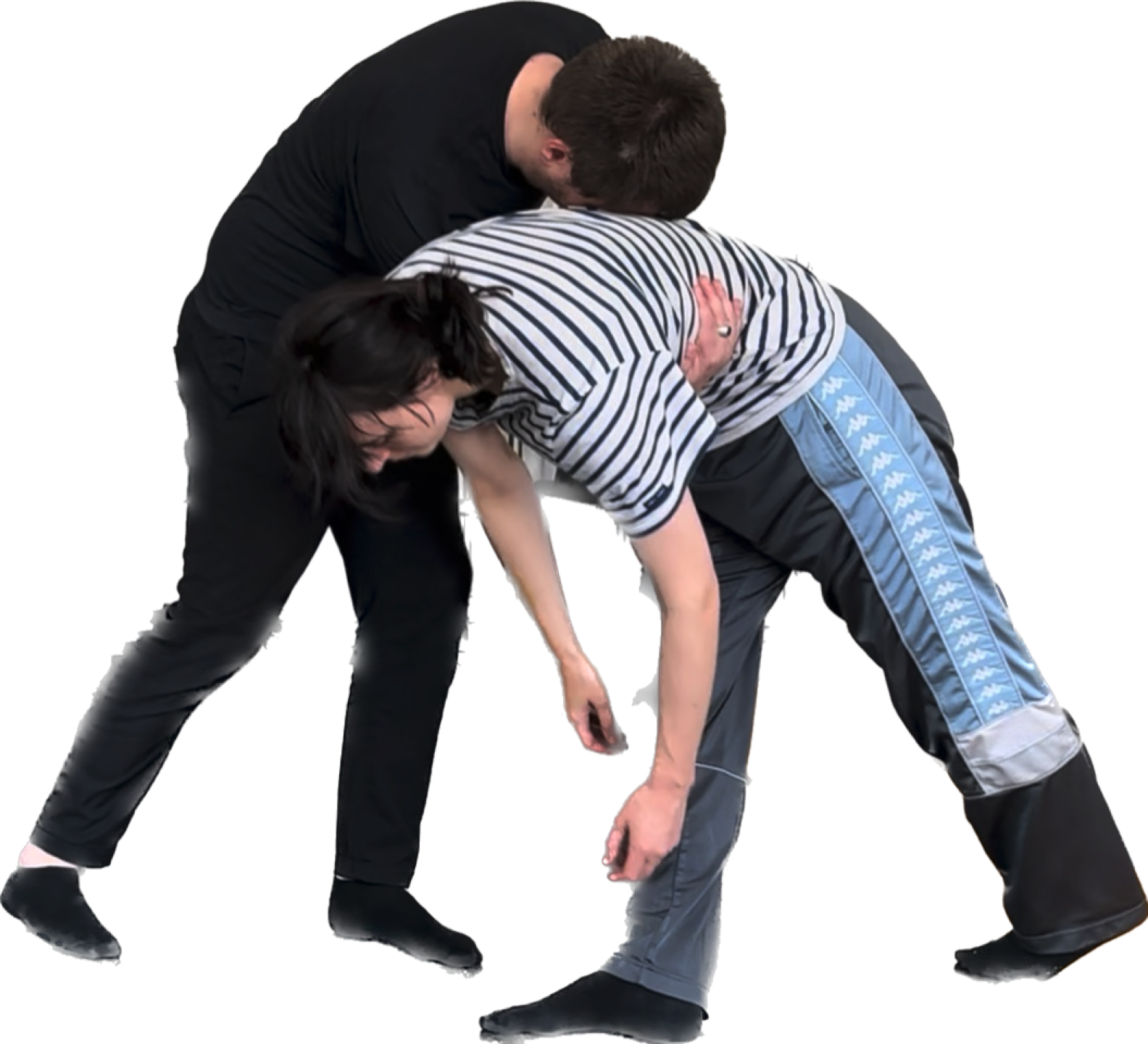
Frederik Klanberg
Principles for Organised Naivety – Frederik Klanberg
As Naomi Hodgson, Joris Vlieghe and Piotr Zamojski have proclaimed in their Manifesto for a Post-Critical Pedagogy “there are principles to defend.” Of course, not only are there principles to defend, but there are principles that are to be shared as an invitation for you to defend or reject them in your own way. In that spirit, this is a thesis about seven principles of organised naivety.
I believe that art academies can be a site of study, possibility and rehearsal for a kinder, more just world. Personally for me, the art academy has been the locus for the most important, formative experiences of my life. Good, bad and ugly - all contributing to the person that I am today. Despite our unimaginative neo-liberal politics, the art academy has been a place of hope. It’s where I have felt that together we can make the world anew. Having studied and worked within the art academy, having criticised the academy and loved the academy, I wish to share my aspirations for the art academy in hopes it can be a transformative space for everyone, as it has been for me. And while the art academy is the specific subject of my writings, I suspect that these ideas are relevant for all critical education.
It is also a thesis about love. Love for education, love for students and love for eachother as practitioners. It is through love that we can exist as Jeanne Heeswijk might say “with, within and against” the institution. Part of the institution, working with it, but also acknowledging that there will be many moments in which the humanity that we cultivate through love for eachother will be far beyond the reach of the tactics of the institution. This is no longer institutional critique, or resistance. This is how we transcend education to the spiritual realm. No amount of policy or institutional planning can operationalise the experience of love. That is something that we do together, as friends.
Eleonora Geortsiaki
Haptic Observations
Eleonora Geortsiaki
Haptic Observations: An exploration of haptic based engagements in arts-based education
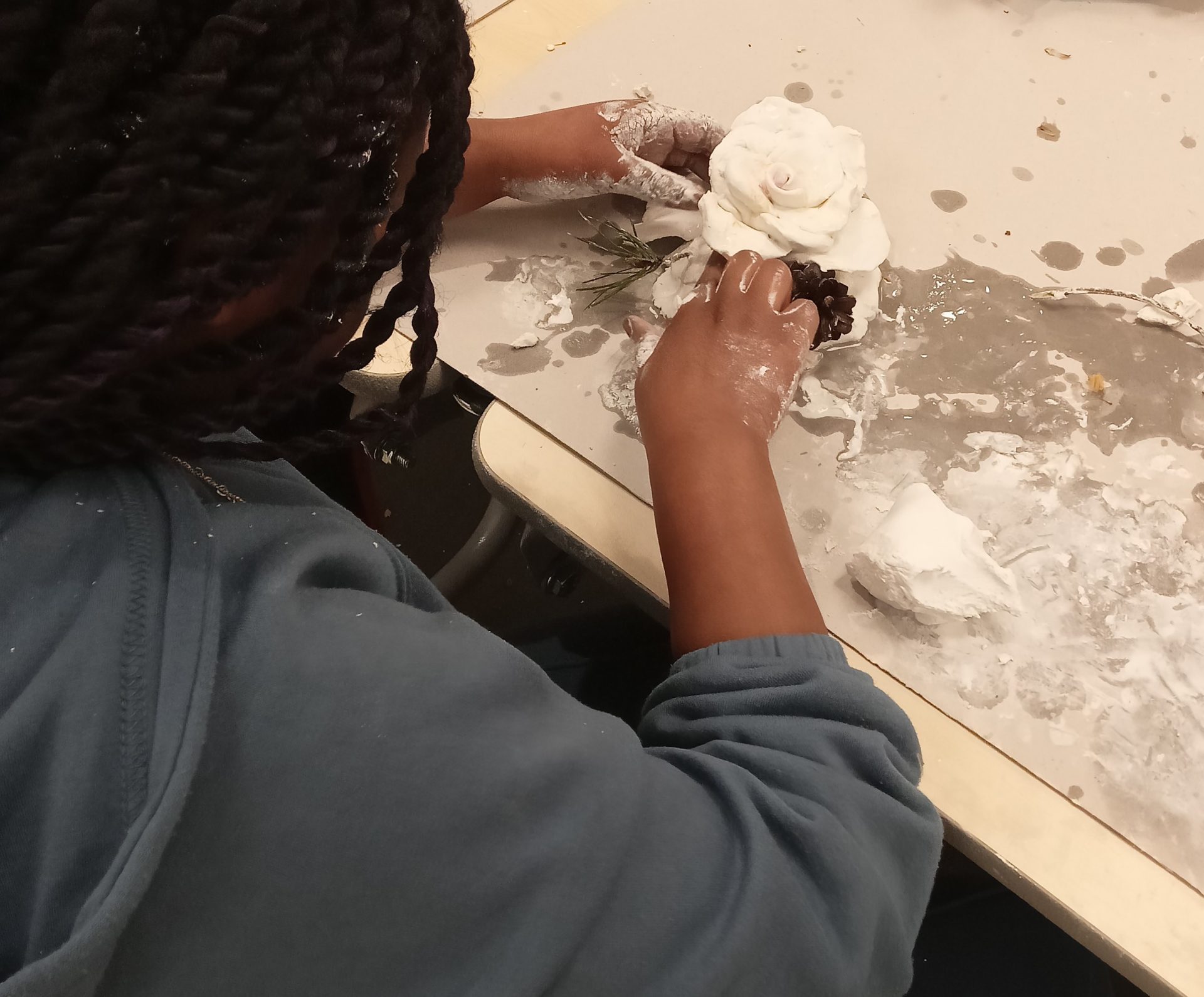
We live in an era that has limited our moments of being with, wondering with and making with real, touch-able materials. Our awareness of our fingers’ gestures is becoming extinct but we still hold an urge to touch and explore the real thing. Haptic arts-based didactics stimulate the sense of touch and turn our attention to the here and now, allowing us to translate abstract contents into tangible artful creations.
This explorative study takes the form of five case studies, which have been conducted with different audiences and at diverse locations, under the framework of a workshop series entitled ‘Haptic Observations’. The research’s main study is to explore how the Haptic Observations workshops foster peoples’ personal perceptions. It does so by structuring the workshops under the notion of ‘attention as a form of education’ and letting participants follow process-driven art-making practices, exploring the not-knowing and being receptive to the new. Some of the workshops in this series study the notion of indirect haptic impressions and explore how haptic experiences could be fostered when touch is not possible. As an educational practice, it invites participants to follow a protocol of actions that aims to navigate them through framed observations toward composing textural and morphological understandings.
Ellis Bartholomeus
Making Space to Get Perspectives by Sharing Perspectives
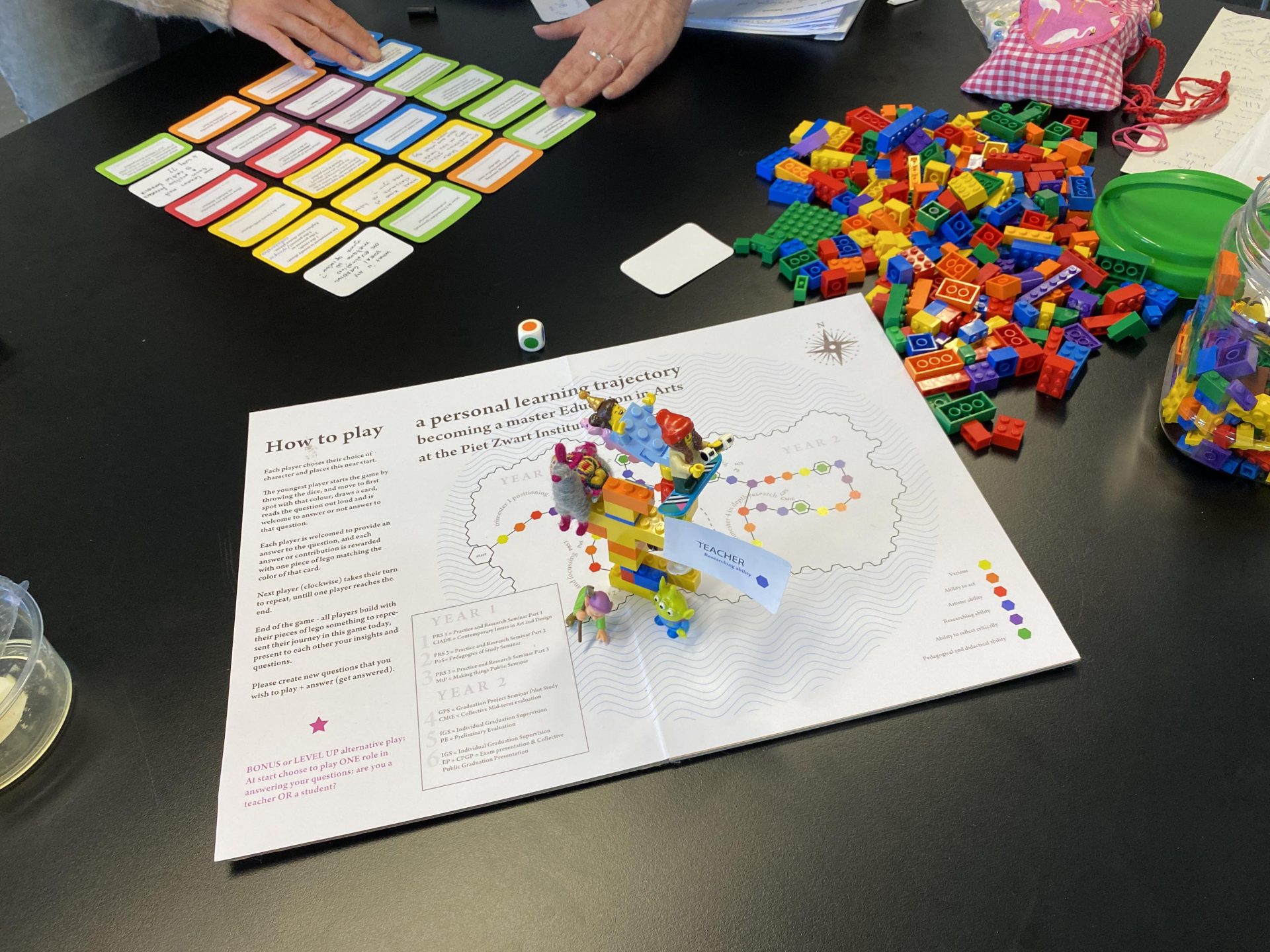
Ellis Bartholomeus
Making Space to Get Perspectives by Sharing Perspectives: Creating a playful tool for higher art education
“That’s kind of what it feels like: there are these props, these toys, and if you pick them up, you can move into some new thinking and a new set of relationships, a new way of being together, thinking together. In the end, it’s the new way of being together and thinking together that’s important, and not the tool, not the prop. Or, the prop is important only insofar as it allows you to enter, but once you’re there, it’s the relation and the activity that you want to emphasise.”
(Stefano Harney and Fred Moten, ‘The Undercommons: Fugitive Planning & Black Study’, p. 106)
This research started off by my being intrigued with the ambiguous role that assessment plays in art education. I asked myself: Why, when and how do we judge or are we being judged as one of the instruments in learning in/with art? I designed several prototypes and experiments to untangle the complexity at stake. This resulted in the development of a game, a playful dialogical tool, to facilitate a delicate conversation between all stakeholders involved in assessment, so that all those involved can feel heard in their need to perform.
Femke Dekker | Loma Doom
Open Field Listening Station
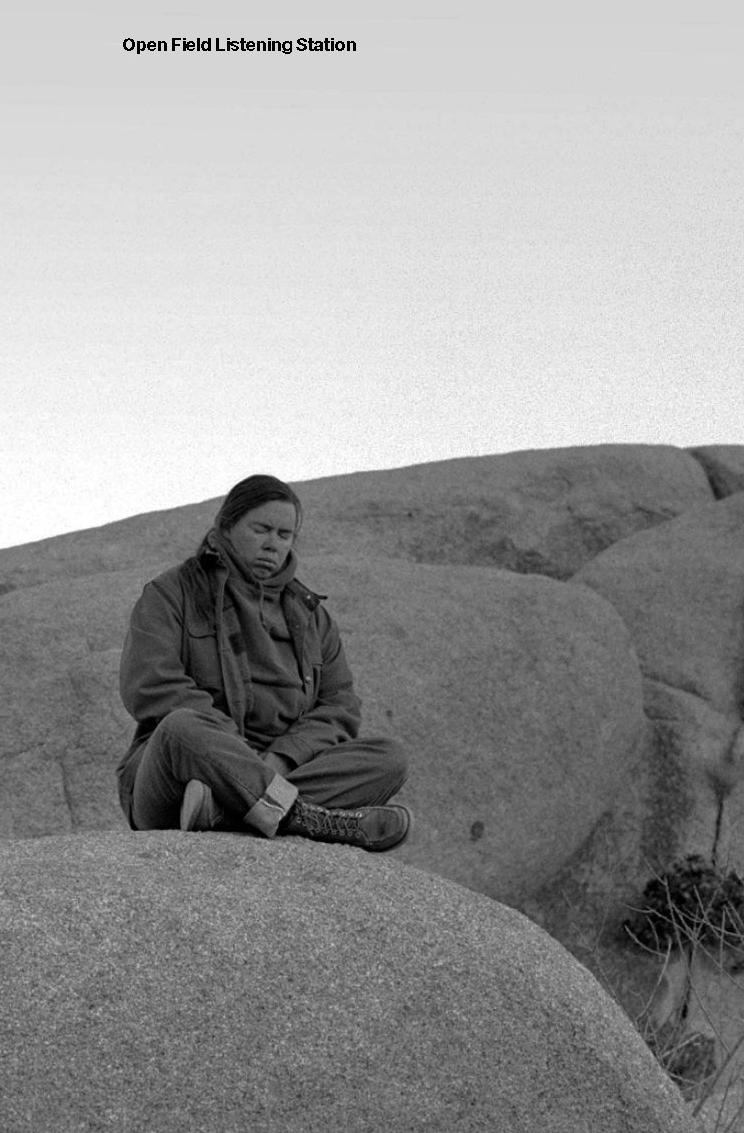
Femke Dekker | Loma Doom
Open Field Listening Station
∞ = 0
I could love my listening
I could listen to me listening
I could perform my listening
I could be my listening
- Pauline Oliveros
Open Field Listening Station is an interdisciplinary dialogue in the context of listening as an artistic practice. As a sound practitioner, the core of my practice – both as an artist and as educator – revolves around listening. Taking my cue from composer Pauline Oliveros, I consider listening a call to action: “Listening is directing attention to what is heard, gathering meaning, interpreting and deciding on action.” (Pauline Oliveros, Quantum Listening, 1999, p. 1.)
But who is listening?
And who is being heard?
What meaning is gathered?
Who decides on the action?
And what kind of action would that be?
Jesse Greulich
Building Pillow Forts
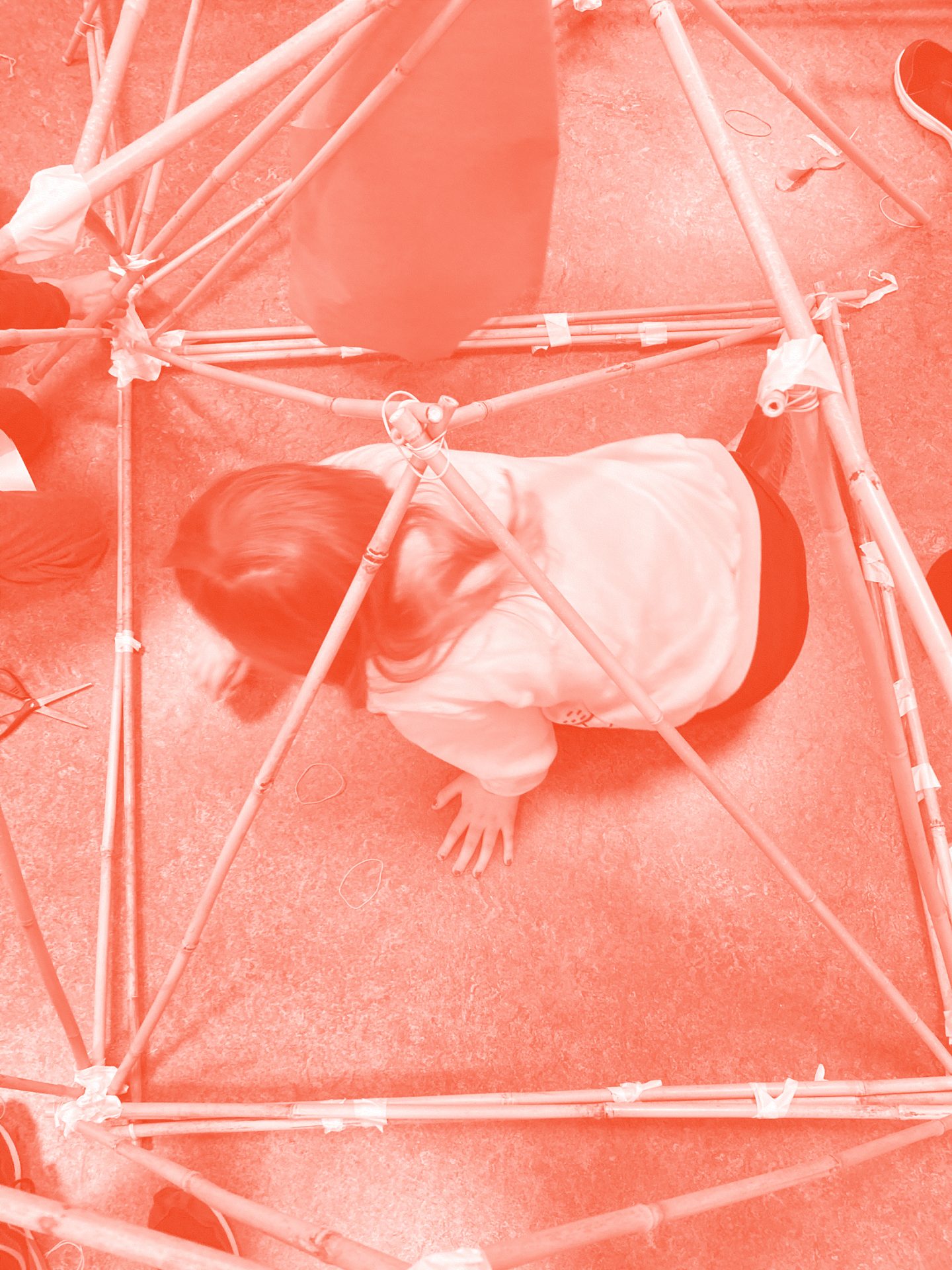
Jesse Greulich
Building Pillow Forts: An embodied learning process
“Space comes into being only when we form situations.”
(Lukas Feireiss, Space is the Place: Current Reflections on Art and Architecture, 2020, p. 89)
‘Building Pillow Forts’ is a research project that takes place within the four walls of a maker space at an international school. It is a shared experience, co-created and shaped through the contributions of 177 learners between the age of 8–9 years old and one facilitator. What started with the question of “What does it mean to own a space?” in relation to the learning environment led to the pursuit of a methodology designed to deliver an embodied learning process.
Leah Sands
Drawing Together
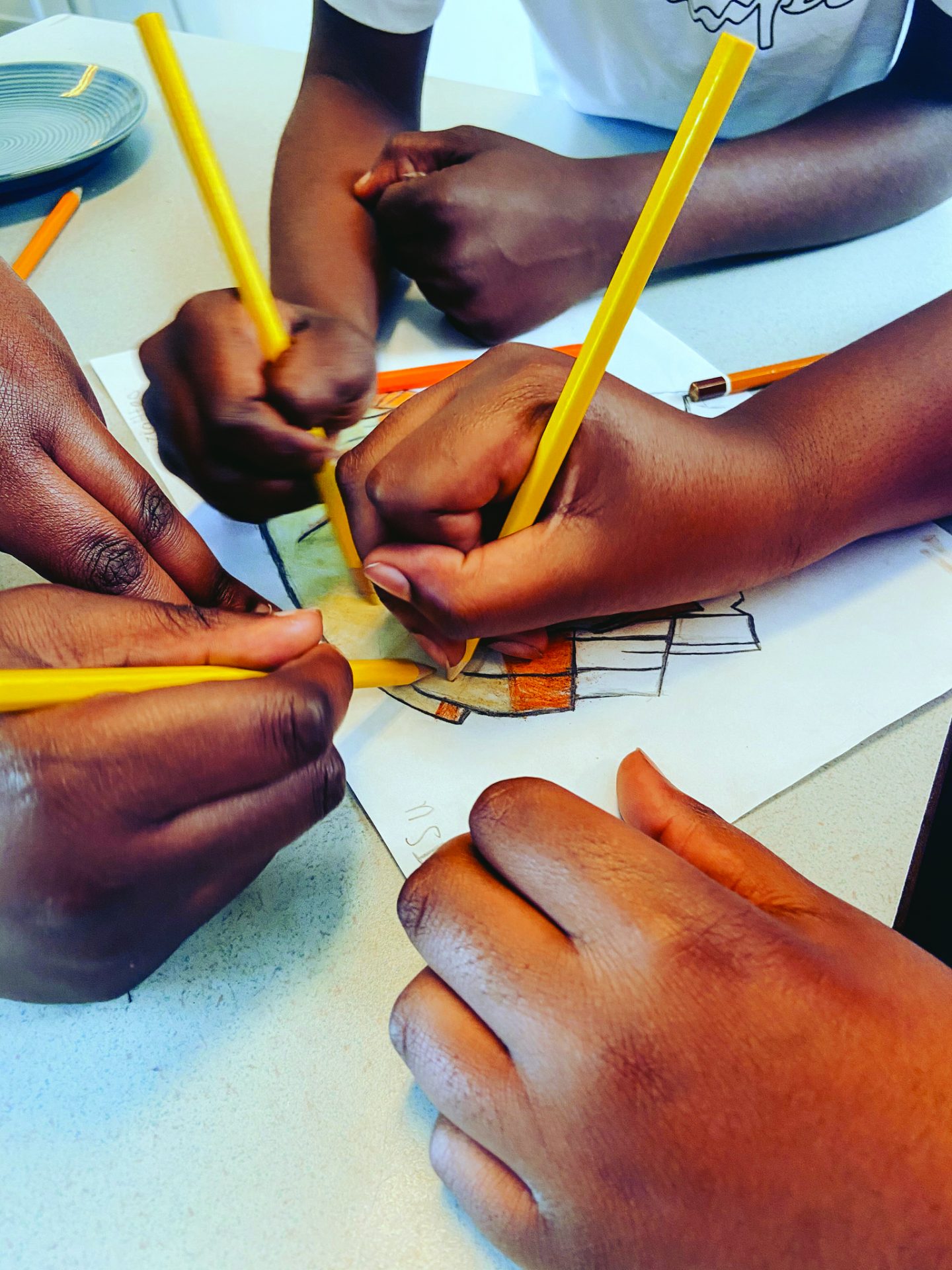
Leah Sands
Drawing Together: How collaborative art-making can create a place of belonging
Throughout my life, two things have been constant: the practice of drawing and my desire for community. Wanting to merge these two aspects has taken me on a lifelong journey, culminating in this graduation project which explores how collaborative art-making can foster a sense of belonging. Specifically, within my art mentorship program in Amsterdam-Zuidoost, called ‘Redefine Arts’, I investigate how drawing together can facilitate vulnerability, conversation, agency and creativity. Since the summer of 2018, Redefine Arts has provided its students with an open studio environment where they can create art and be inspired. Beyond creating opportunities for students, I wanted to extend my focus to creating a safe space for students to grow relationally with each other.
Louise Kleijweg
The Language of Visual Arts
Louise Kleijweg
The Language of Visual Arts
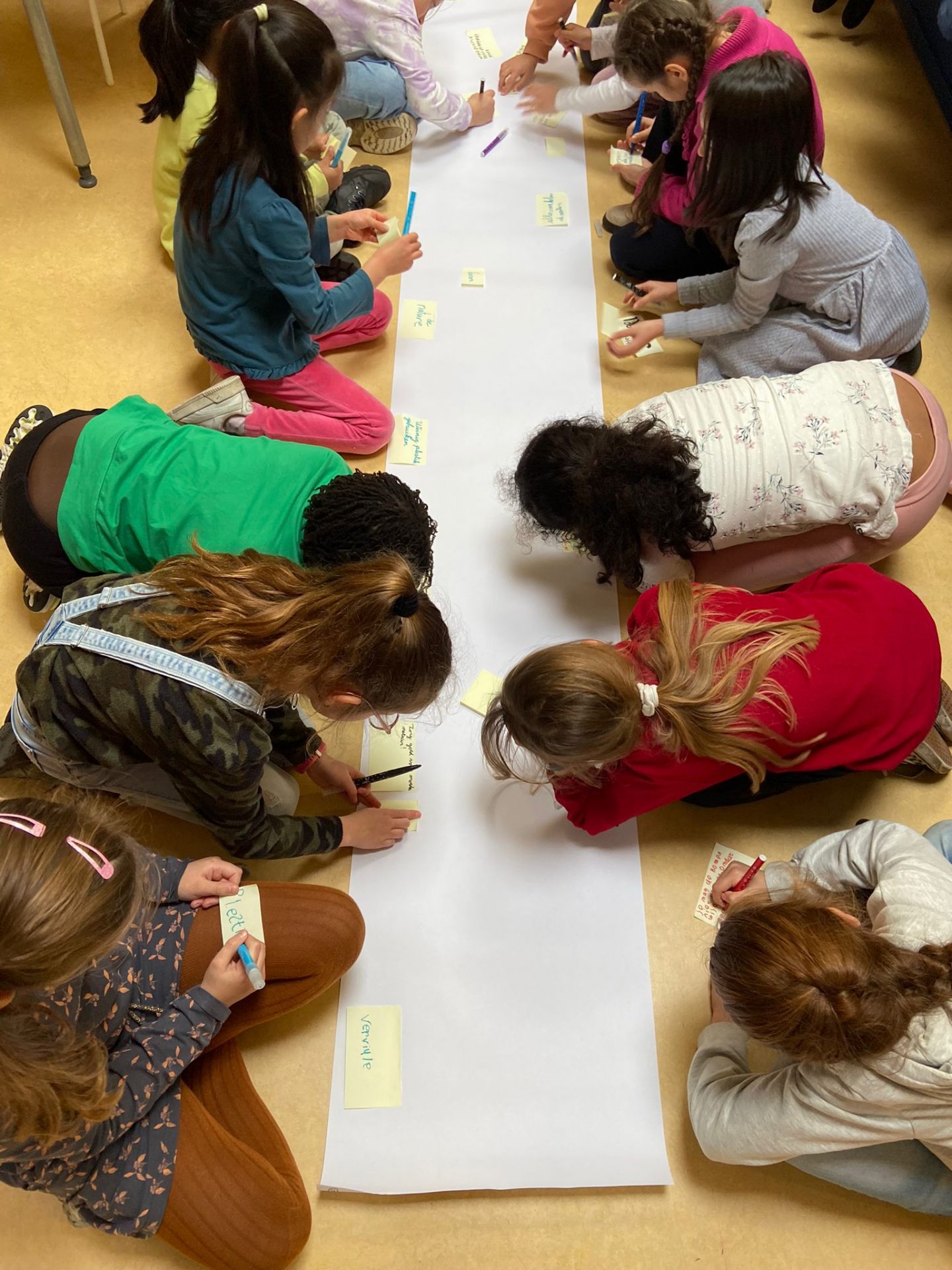
The Language of Visual Arts is a graduation project focusing on process-based learning at the intersection of visual arts and creative writing. This project strives to realize qualitative education in visual arts and creative writing by focusing on the creative process. By alternating divergent- and convergent-thinking activities, students are encouraged to expand their ideas and use critical thinking to make selections and develop their written and visual artwork. Integrating moments of reflection and actively making selections throughout the process is vital for the quality of the work and the process.
Maaike van Papeveld
Mending Mirrors
Maaike van Papeveld
Mending Mirrors: A proposition for facilitating reflection otherwise
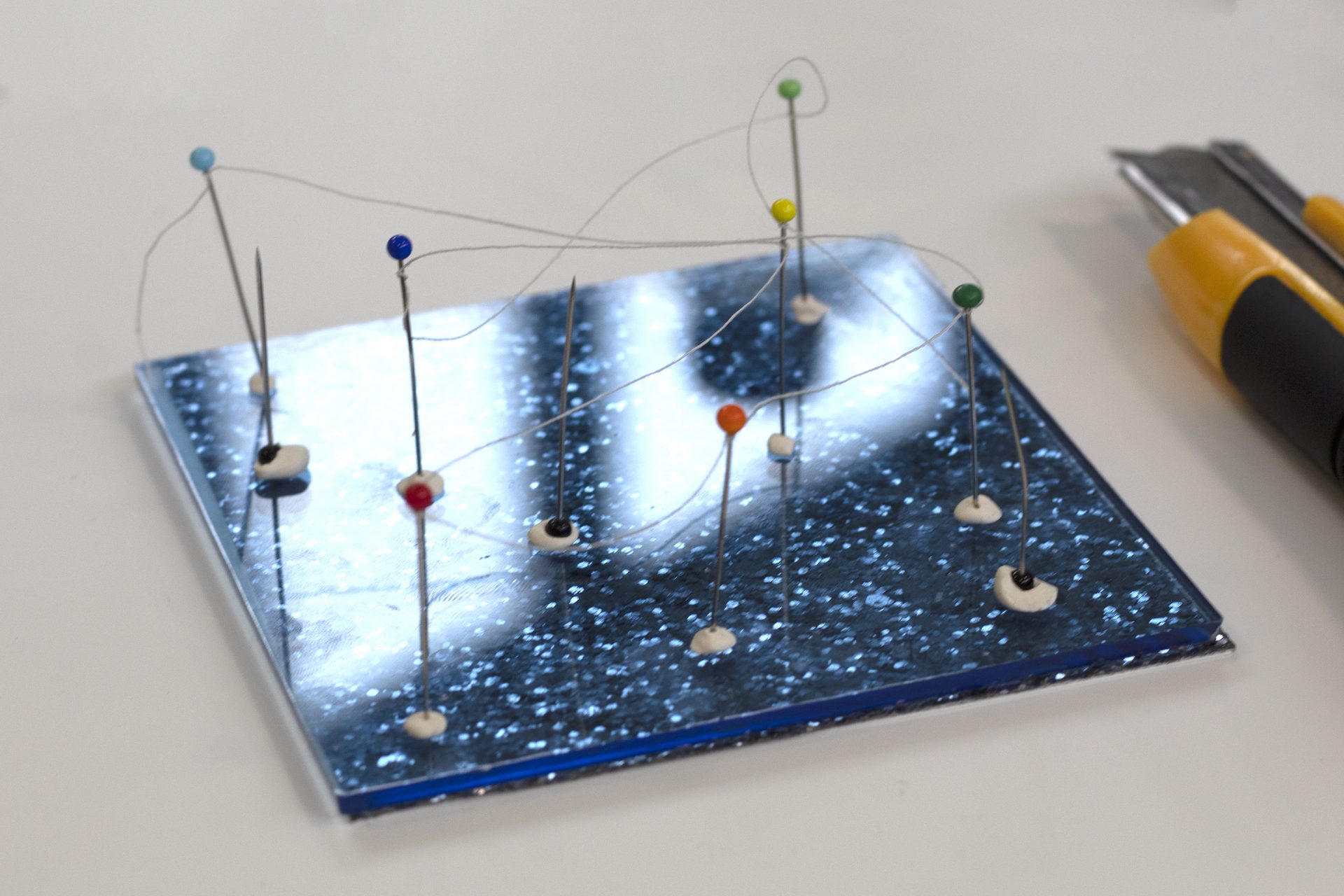
Over the past two decades, reflection has become an immensely popular term within international educational contexts. This is not surprising, because it seems to have a lot to offer: it contributes to personal and professional development, improves our ability to respond to practical challenges and deal with complexity, helps us challenge our assumptions and expose inherent bias – and the list goes on. Some argue that self-knowledge generated through reflection can lead to personal transformation and emancipation – effects that may not only benefit individuals but even society at large. In the face of today’s issues that are riddled with complexity – and that urgently require well-considered decisions and meaningful actions – reflection is perhaps more desirable than ever.
Natalia Amelia Saied
How do you know when you know?
Natalia Amelia Saied
How do you know when you know? Tools for spectatorship and reflection
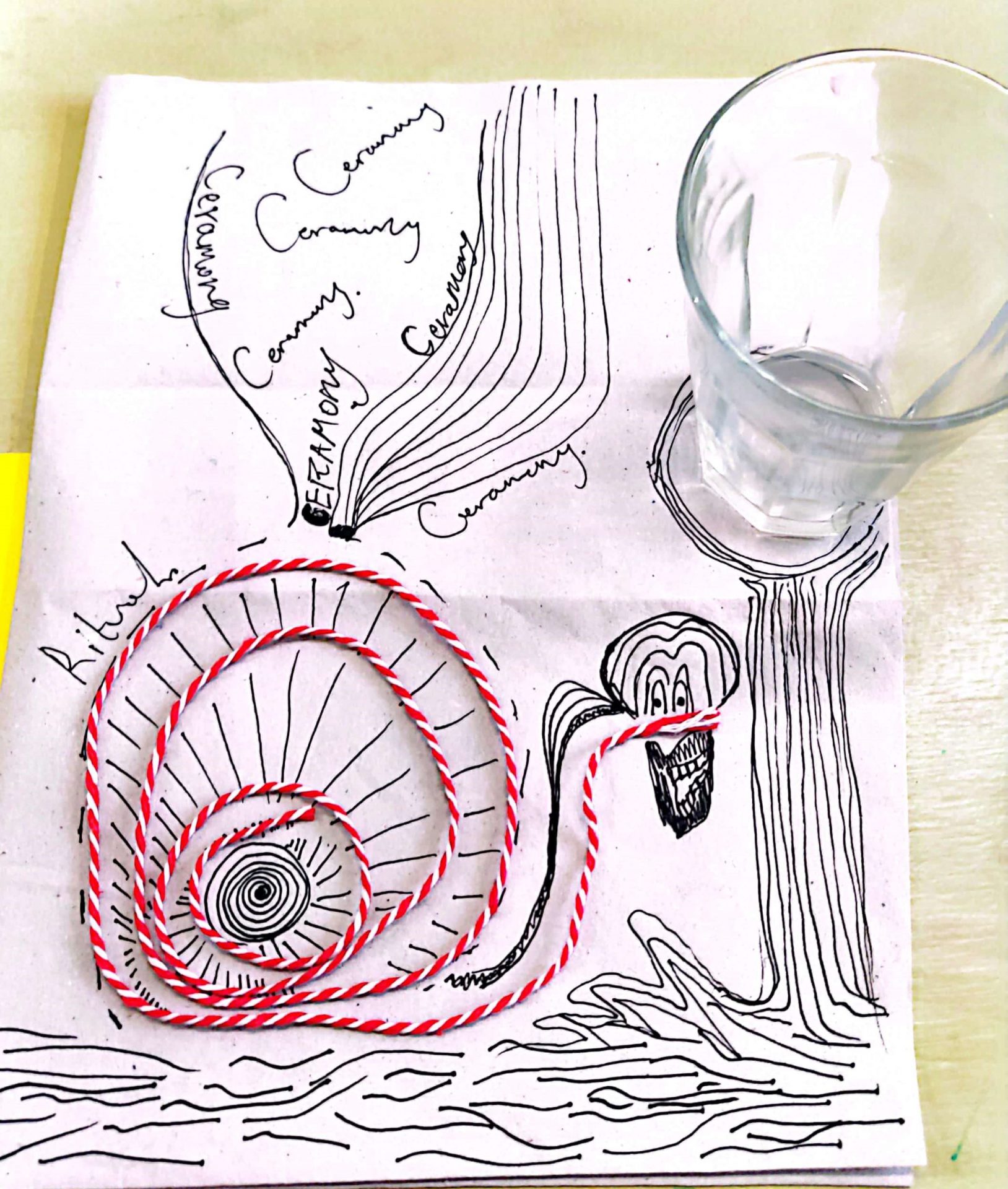
My graduation project questions how an ignorant host’s pedagogy can facilitate emancipated visitors in the contexts of museums and dance performances. Using movement improvisation principles and Jacques Rancière’s work, my research aims to push the boundaries of the traditional art encounter, which is usually regulated by art institutions. Rather than taking an explicatory and instructive approach, I invite to suspend judgment and guide the participants toward reflective inquiry.
Jesse van Oosten
Learning in the Spaces Between Words
Jesse van Oosten
Learning in the Spaces Between Words: Toward an intimate pedagogy for my theory classroom
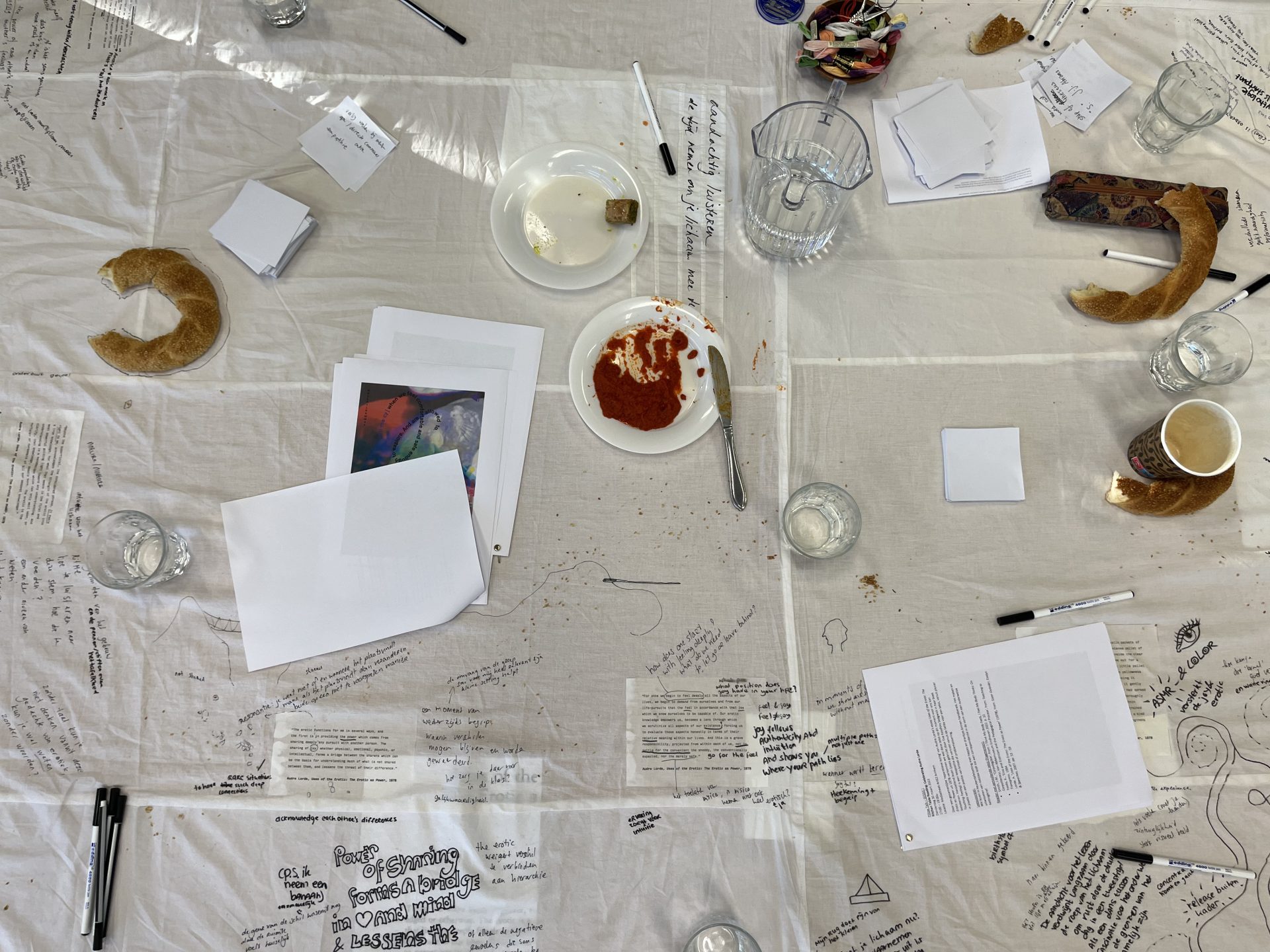
This research starts from a personal desire to do things otherwise in my theory classroom, in the context of institutions for higher arts education and in relation to the complexity of today’s times. When pondering my own educational history, especially as a university student, I can easily recall the feelings and bodily sensations that arose in the time and space of those institutions. When understanding education as an affective encounter, I wonder how we can make more sense of embodiment in the theory classroom, while acknowledging that learning is as much about feeling as it is about thinking.
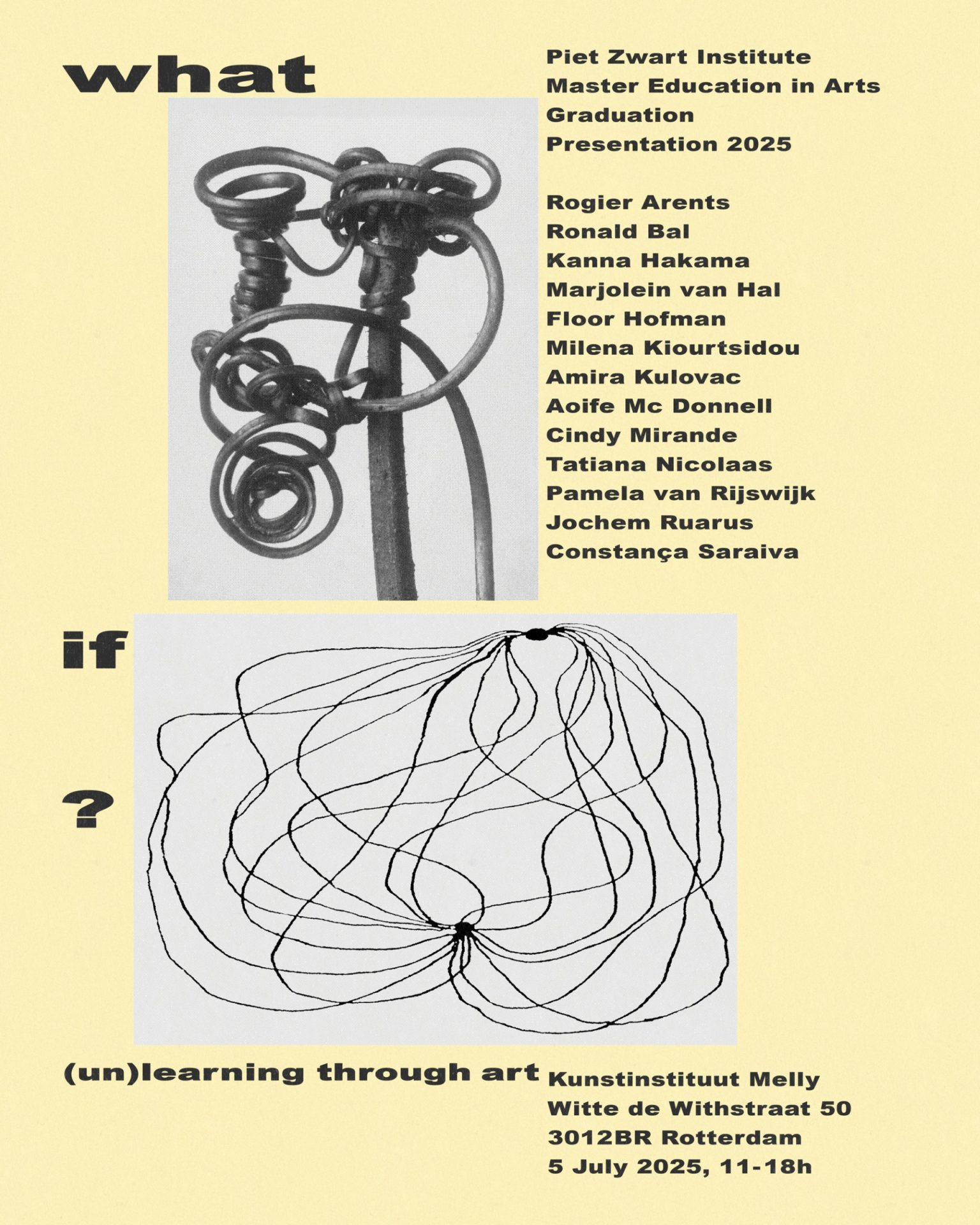
Graduation Presentation 2025
Master Education in Arts
Piet Zwart Institute
Willem de Kooning Academy Rotterdam University of Applied Sciences
·
5 July 2025
11:00–18:00
Kunstinstituut Melly, Rotterdam
·
With:
Rogier Arents, Ronald Bal, Kanna Hakama, Marjolein van Hal, Floor Hofman, Milena Kiourtsidou, Amira Kulovac, Aoife Mc Donnell, Cindy Mirande, Tatiana Nicolaas, Pamela van Rijswijk, Jochem Ruarus, Constança Saraiva
·
Curated by: Angela Serino, with the help of all the students, and Sjoerd Westbroek
Programme of Live Events
11:00 – 17:00
Ongoing throughout the day:
Ronald Bal, Dream Abilities, performance
Cindy Mirande, Gifts of Attention, drop-in workshop
Constança Saraiva, What Glues Us Together? Pedagogies of the Book Anatomy, drop-in workshop
11:00
Collective publication launch
12:00
Rogier Arents, Micro-suspensions of Play, performance (10 min)
13:00
Milena Kiourtsidou, Drawing Ritual, performance (10-15 min)
14:00
Floor Hofman, From Interview to Dialogue: For Connection and Mutual Understanding, public presentation (30-45 min)
15:00
Rogier Arents, Micro-suspensions of Play, performance (10 min)
16:00
Tatiana Nicolaas, Documenting Living Heritage and Navigating Cultural Identity Through Art, live interview (about 1 hour)
Works in the space by: Rogier Arents (Micro-suspensions of Play), Ronald Bal (Dream Abilities), Kanna Hakama (From Holding Space to Potential Space), Marjolein van Hal & Amira Kulovac (Acts of Learning), Milena Kiourtsidou (Drawing Ritual), Aoife Mc Donnell (Language Bodies), Cindy Mirande (Gifts of Attention), Pamela van Rijswijk (The Kizuki Cycle), Jochem Ruarus (Every A3 Paper is a Classroom), Constança Saraiva (What Glues Us Together? Pedagogies of the Book Anatomy).
sauli
test- sauli
sauli
test
test
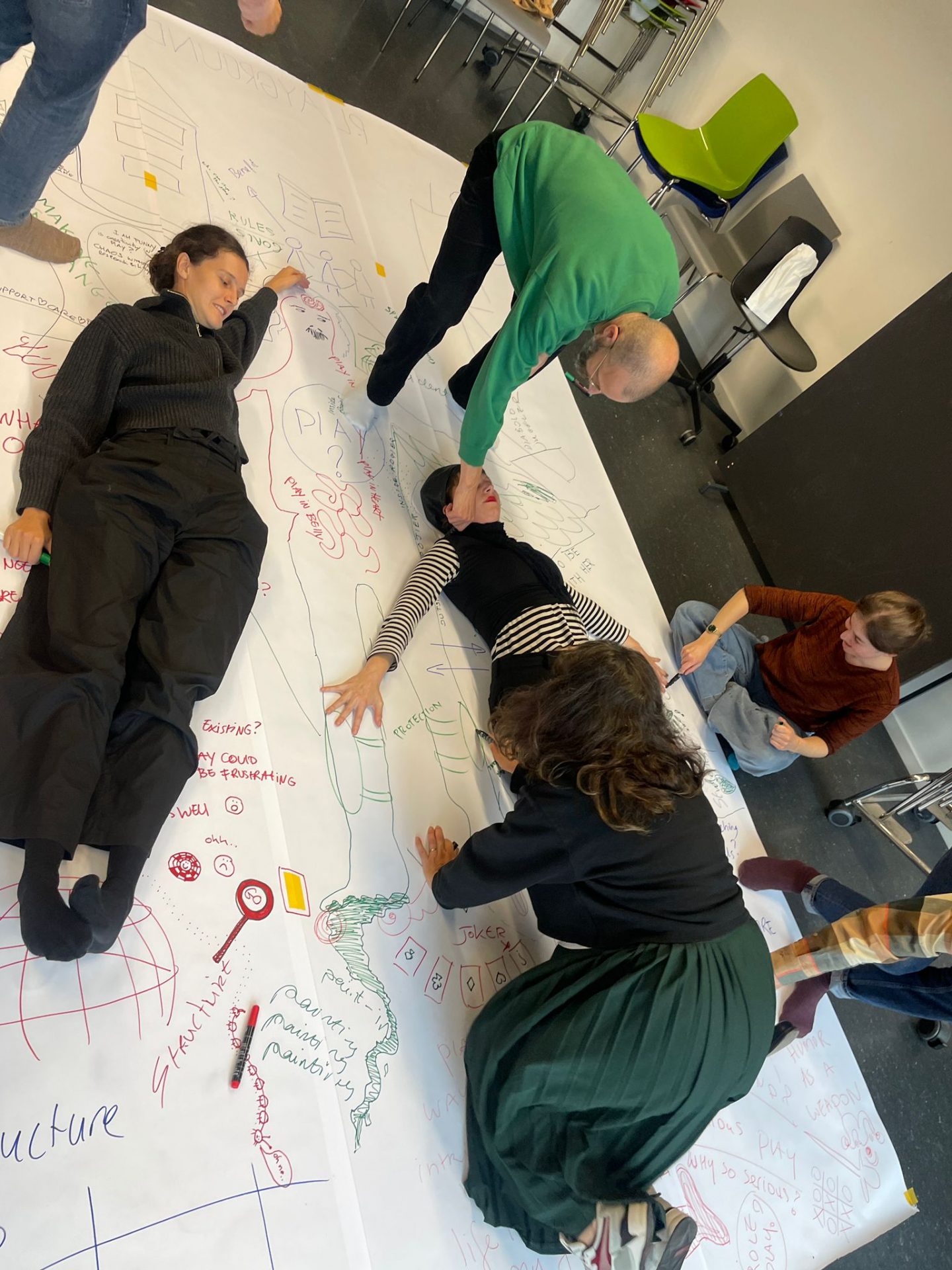
Rogier Arents
Looking At Art Education Through The Lens Of Play
Rogier Arents
Looking At Art Education Through The Lens Of Play – Rogier Arents
Being a student (again) at MEiA reawakened my playful side. It sparked a curiosity about the connection between play, school, and learning. I had always thought of play as something that happened outside of school—during breaks, or quietly, when the teacher wasn’t looking. But that idea doesn't align with the fact that children naturally learn through play.
In the thesis, a fictional conversation between me and authors, theorists, and researchers in the field of play and education leads to a synthesis between theory on education and theory on play. I discovered that school is, in many ways, built on the same foundations: a safe space removed from everyday life, with defined roles, clear rules, and a specific focus—such as developing skills and knowledge.
Recognizing the connection between play and education, I began incorporating playful conditions into my art and design classes at ArtEZ. I aimed to create an environment that reminded both students and tutors that we are already engaged in a form of play. I experimented with methods like role-play, storytelling, game design, physical exercises, and theatrical forms of play.
What proved especially effective was introducing short, intense moments of play at the start of class. These playful interludes helped set a tone—an attitude of curiosity, engagement, and openness—that carried through the rest of the session. This mindset not only supported the learning process but also enriched creativity.
Kanna Hakama
From Holding Space to Potential Space
Kanna Hakama
From Holding Space to Potential Space – Kanna Hakama
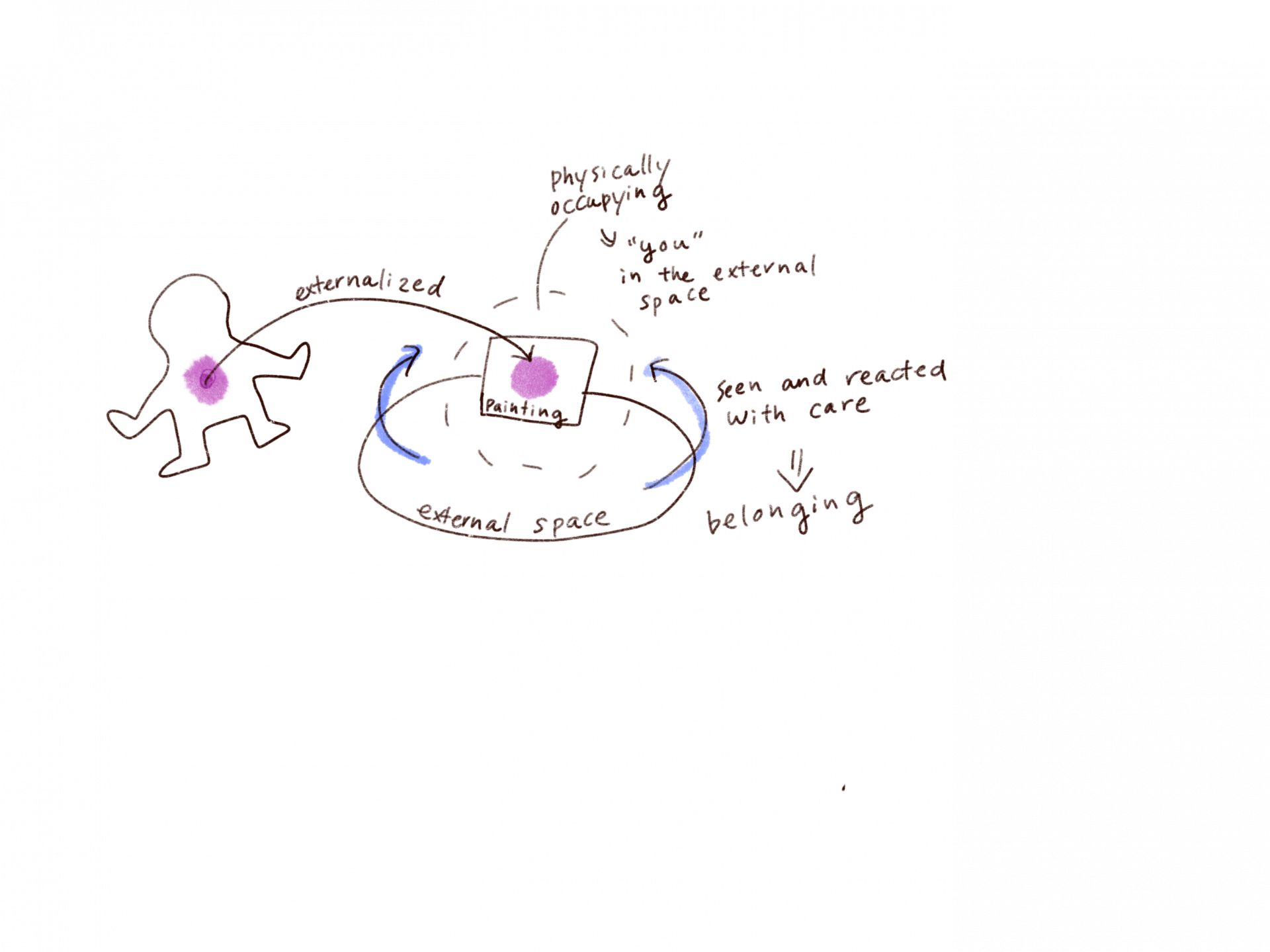
This research is rooted in my practice as a painter, where I have experienced painting as a process of inquiry and self-reflection. Each choice of color, form, or texture becomes a way of responding to inner questions and revealing personal meaning. In working with children, I observe that painting often begins as an instinctive and emotional act, offering a natural path to self-expression. Through gentle questions like “Why did you choose this color?” painting becomes a way for children to explore and articulate what may not yet be put into words. My role as an art educator is to create a space where this kind of exploration feels safe and supported. In such an environment, painting transforms into a process of inquiry and discovery, helping children connect with their inner world and express it outwardly through their artwork.
Marjolein van Hal
The Usefulness of the Useless
Marjolein van Hal
The Usefulness of the Useless – Marjolein van Hal
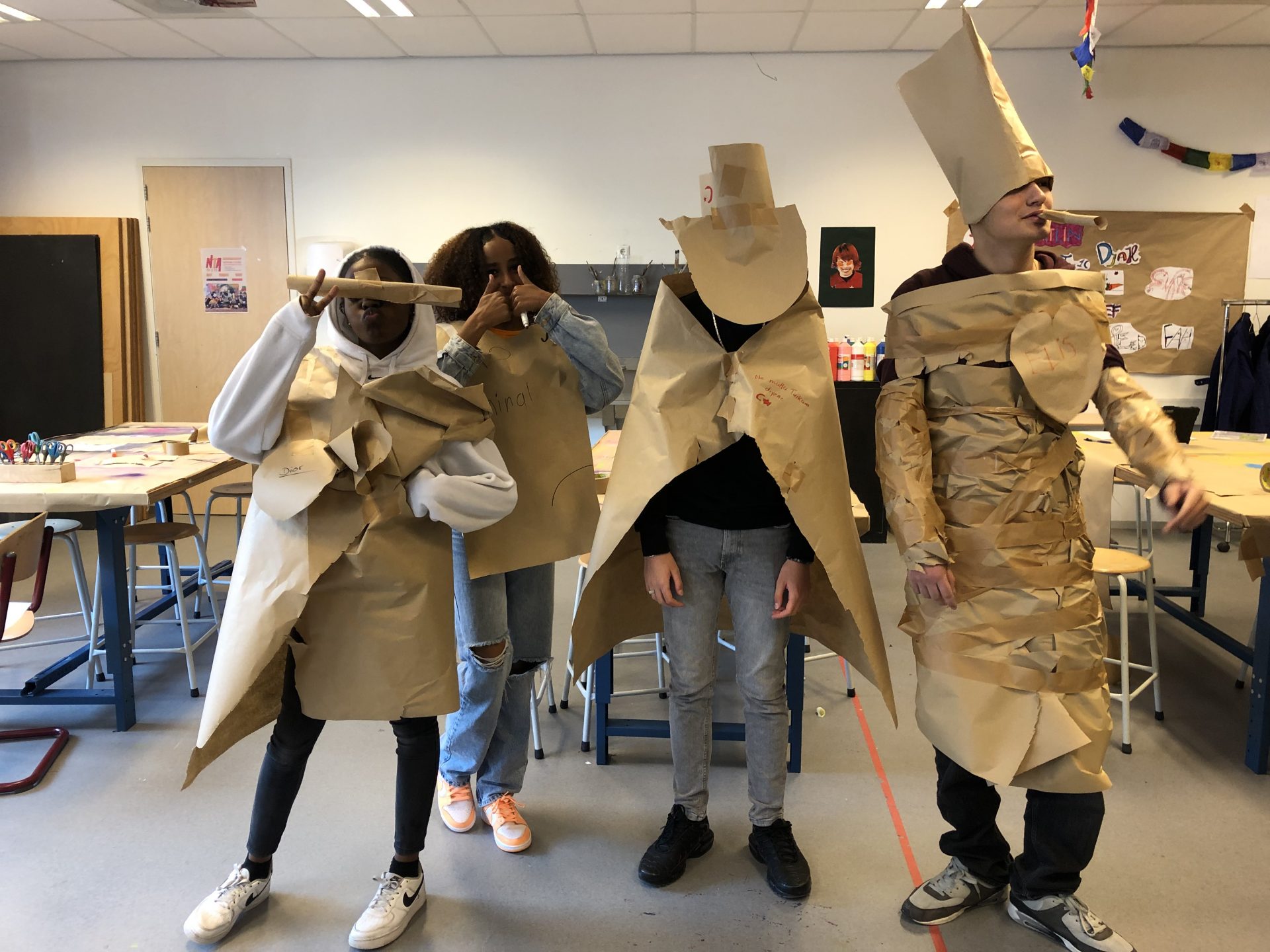
What happens when we no longer see art lessons as “time between tests,” but as rehearsal spaces for life? In my practice-based research, I explore how art education can offer students room to appear — to rehearse who they (want to) be, to make sense of their experiences, and to raise their voices in a world that often primarily values measurable performance.
As a teacher of art in vocational secondary education (VMBO), I see the consequences of this performance-driven system unfold year after year. Students arrive carrying a backpack full of insecurities — often shaped by the pressures they already experienced in primary school. More and more, I find myself asking: What is the true purpose of our education system?
From my own classroom practice, I began to zoom in: how can I give both myself and my students more space to appear, to slow down, to reflect? How can I create moments that go beyond outcomes, where students can experiment with who they are — and who they might become? And how can I offer something meaningful back to an educational culture where the pressure to perform often overshadows the process of becoming.
My central research question is: how can we make the value of the art class as a rehearsal space visible within an education system strongly focused on testing and measurement?
This research is an invitation — to fellow educators, school leaders, and all those who believe that within the “useless” moments of art lies something deeply necessary: the space to rehearse, to reflect, to appear.
Let’s practice. Together.
Floor Hofman
From Interview to Dialogue: For Connection and Mutual Understanding
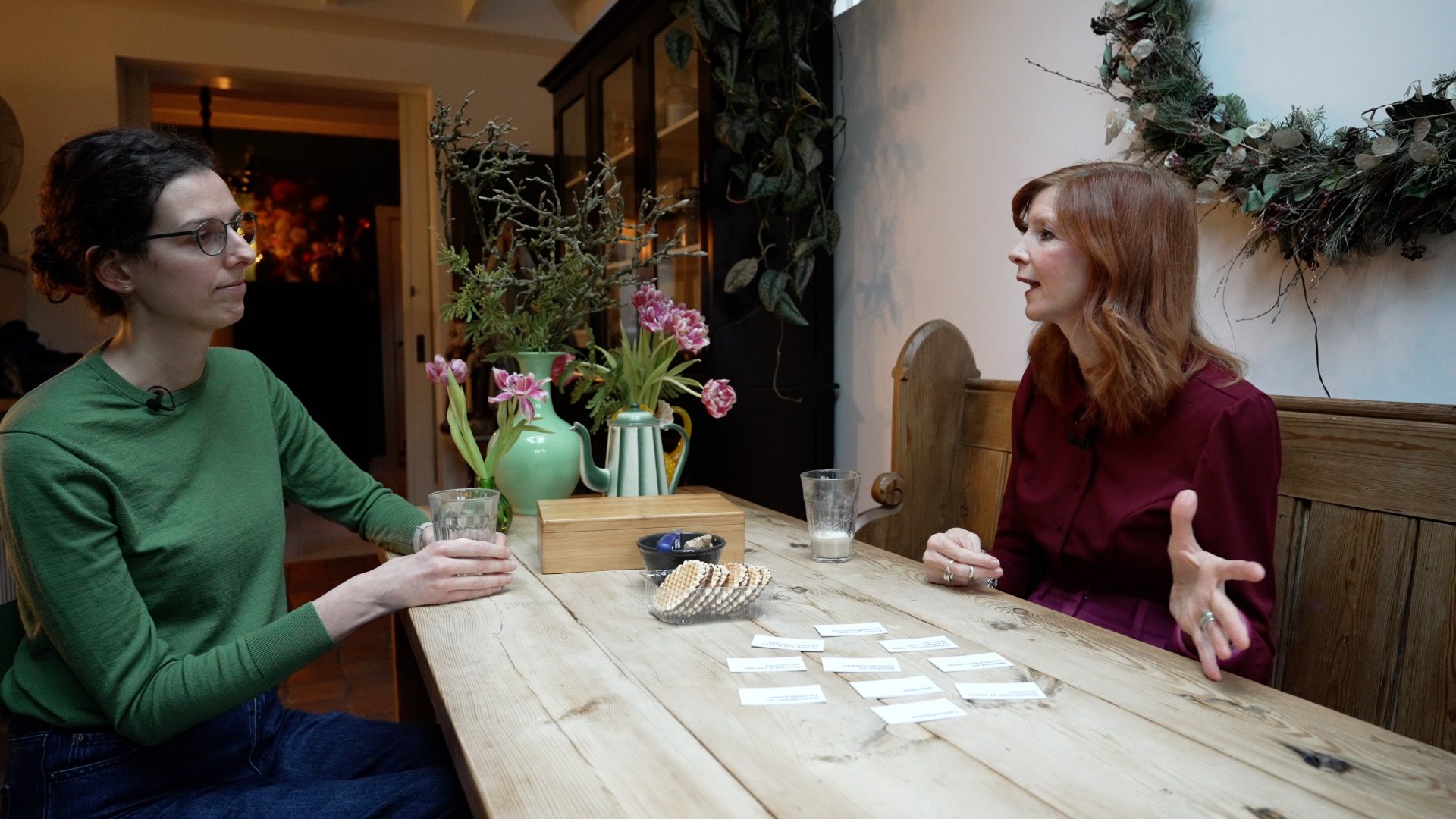
Floor Hofman
From Interview to Dialogue: For Connection and Mutual Understanding – Floor Hofman
What if interviews could not only collect stories but also create connections? In my graduation project, I explore how interviews can become pathways to mutual understanding. Inspired by my own feelings of alienation as a teenager and my work as a documentary filmmaker, I investigated how interviews can help people to share the meaning behind their life experiences. I worked with two groups: design students and individuals with connective tissue disorders. Using interview tools like lifelines and guided tours, I found that these methods gave participants more control over their narratives and allowed them to uncover new insights. By recording and then re-watching these interviews together, and engaging in group dialogues, participants found recognition and connection, both with each other and within themselves. In my thesis, I show how these accessible tools can create connection in educational and community settings.
Milena Kiourtsidou
Drawing Ritual: A practice to cultivate attention, presence and experimentation in educational environments
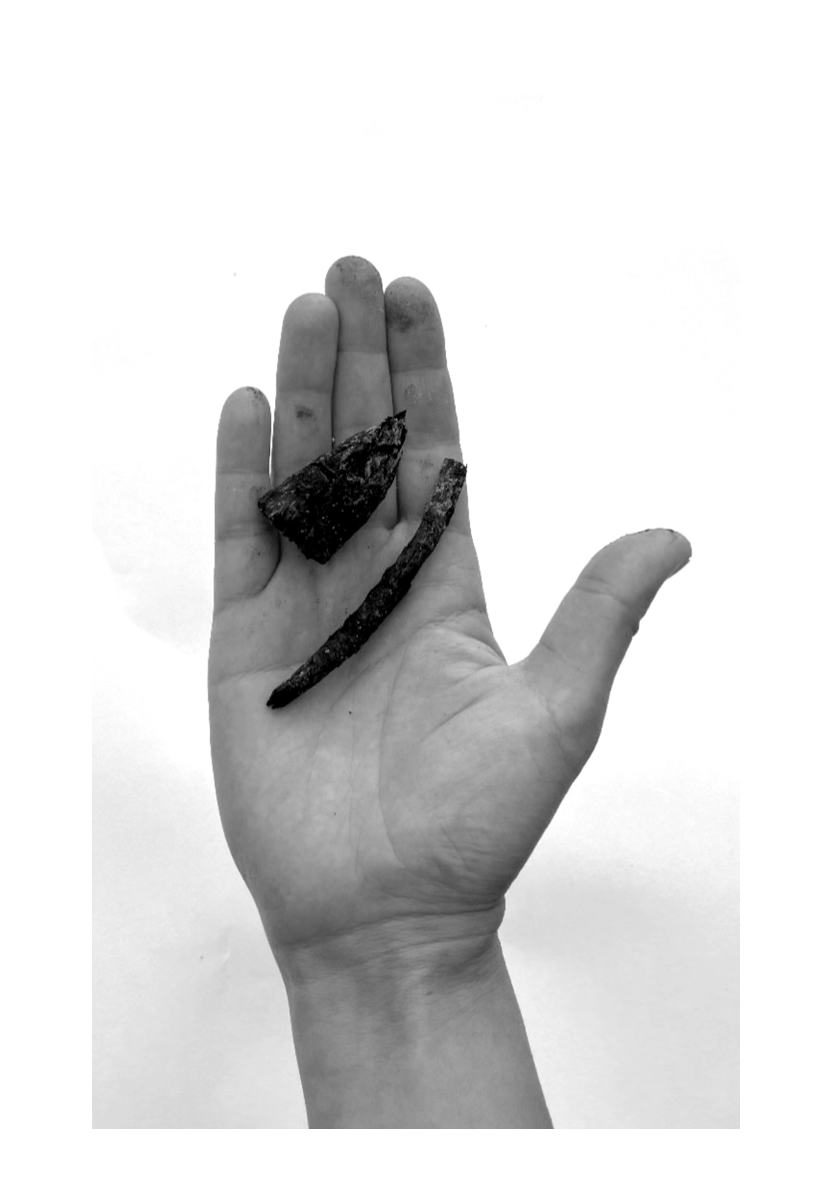
Milena Kiourtsidou
Milena Kiourtsidou – Drawing Ritual: A practice to cultivate attention, presence and experimentation in educational environments
What if drawing would be a pathway of learning from within? Through my graduation research, I explored how drawing, as a meditative and intuitive practice, can cultivate attention, presence, and experimentation within educational environments. How can this
practice help to connect to self, others and the world around us? In this regard, drawing is not just a technical skill but a ritual, a practice that goes deeper than technique alone.
Rooted in my own artistic and facilitation practice, I designed and conducted workshops in both formal (ArtEZ, Willem de Kooning Academy) and informal (an art residency in Tuscany) settings. My research focused on creating conditions where the creative process is prioritized over outcomes, emphasizing slowness, repetition, and creating a non-judgmental space. I worked with three core elements: Attention, Presence, and Experimentation (APE), observing how these interrelate during drawing activities. Across the different pilot studies, I witnessed how drawing supports a shift from result-driven thinking towards a more open, intuitive state of being and creating. Participants reported entering states of flow, discovering new approaches, and allowing unexpected ideas to emerge through simple, focused exercises.
Rather than offering drawing as a tool for relaxation, my intention was to investigate how pedagogical spaces can support experimentation and inner creative discovery. My findings suggest that by guiding students mindfully and allowing space for uncertainty, drawing can activate new pathways for artistic processes, learning and ways of being.
Amira Kulovac
If I could turn back touch
Amira Kulovac
If I could turn back touch – Amira Kulovac
In this research I explore my personal need to reintroduce the tactile into the classroom. As digital tools have increasingly dominated education, I’ve found myself longing for more hands-on, physical experiences in my teaching. By working with different materials, I aim to understand how physical creation can evoke emotional engagement, both for my students and myself.
This exploration is rooted in my desire to move away from abstract, screen-based learning and return to something more visceral, something that can be truly felt. Through engaging with materials in a tactile way, I’ve discovered that it enables me to foster deeper connections and create a classroom environment where emotion and cognition work together.
For educators, particularly in higher education, this work may offer insights into how to integrate more tactile and embodied learning methods into their classrooms, fostering deeper emotional engagement with students.
Aoife Mc Donnell
Language Bodies
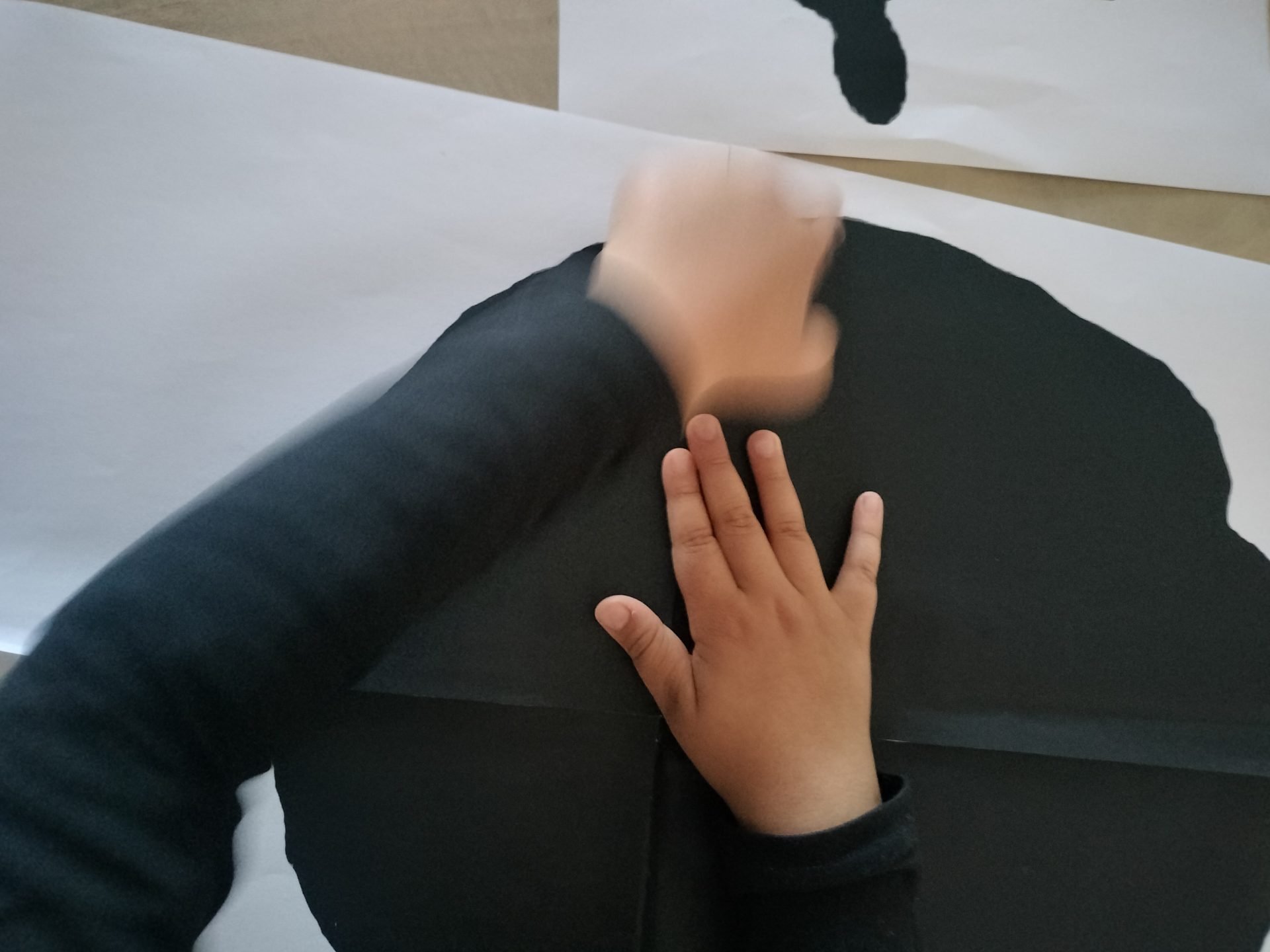
Aoife Mc Donnell
Language Bodies – Aoife Mc Donnell
This research project was carried out with young children learning a second language (English) in informal settings- at home, in community centres, after-school care, etc. My aim, as both a language teacher and arts facilitator, was to understand if and how artistic strategies and material-based exercises, informed by new materialist theory, could give opportunity to students to connect and express their personal experience, viewpoint, and sensibilities through a second language. I examine the idea of ‘immersion’- a commonplace concept within language learning and teaching discourse- first through my own experience both a language student and teacher, then through a series of body/sensory engaged exercises. Doing so, I intend to stretch this concept of immersion further to consider the world and experience of the student and their native language in relation with the physical process of acquiring a second language.
Nicole Menthen
Building an Art Class Community
Nicole Menthen
Building an Art Class Community – Nicole Menthen
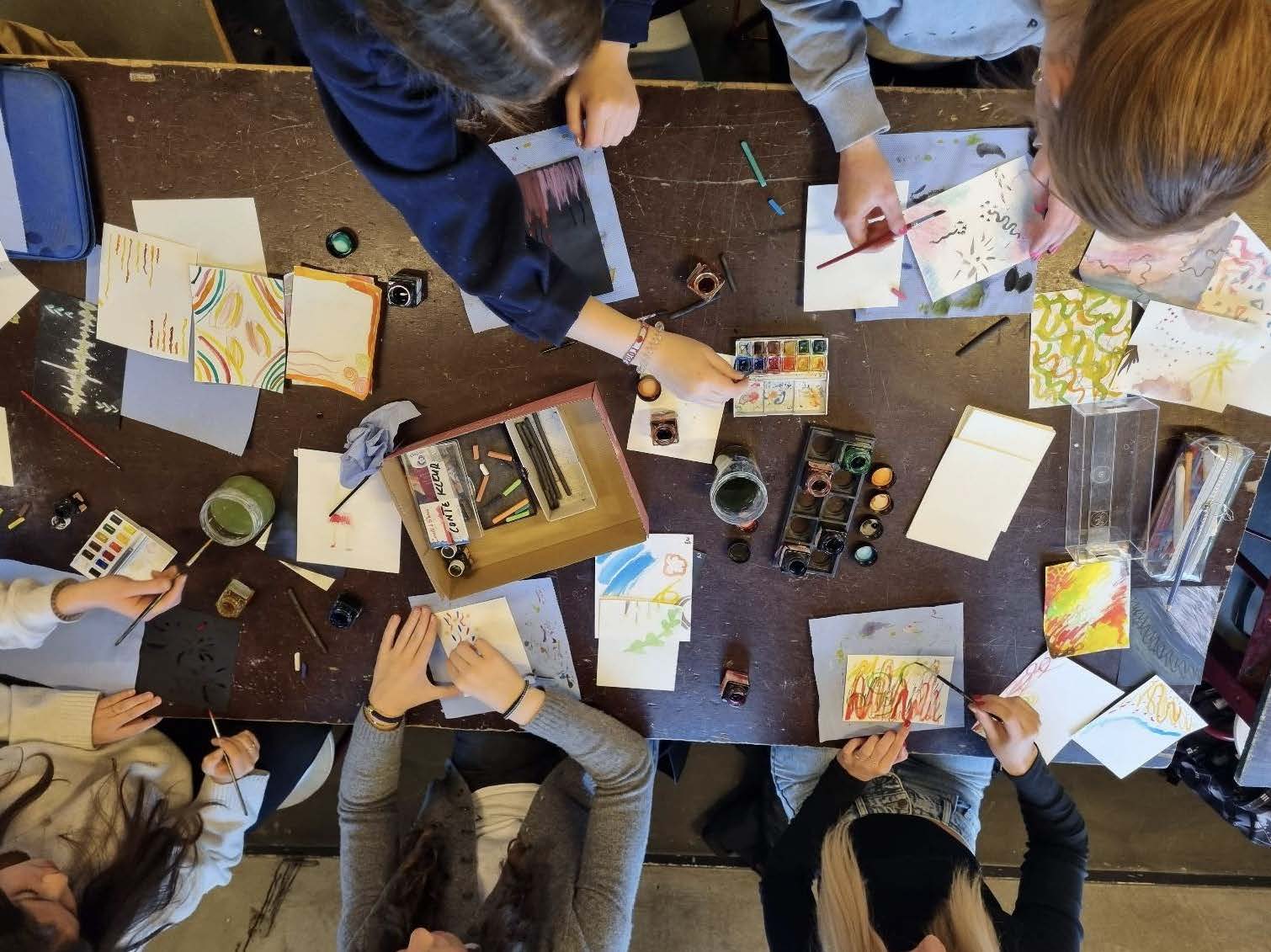
Life at a high school is often experienced by its students as a place of great social pressure, caused by the pressure to be successful, and having to deal with prejudices and opinions of peers. As an art teacher, I experience that, due to the existence of social boundaries, students of my advanced art class do not feel comfortable enough to express themselves in making art, in being authentic - expressed by the 18th century Romantic-Essentialist, Philosopher Jean Jacques Rousseau as ‘being true to oneself’.
In this research I introduce a different, more social way of learning and working based on shared learning among students and teacher. I developed a method of playful, art-based, group check-ins for creating new spontaneous connections. The concept of this method is based on the reflective power of students, while showing vulnerability in sharing identity through storytelling and dialogue. In this way, students can empathise more easily with others, which is more likely to lead to connections, thus also generating more authenticity in making art.
Cindy Mirande
The Art of Shifting Perspectives
Cindy Mirande
The Art of Shifting Perspectives – Cindy Mirande
The Prismatic Gaze within Creative Research and Design Education:
A Discovery Compass
What if attention is the most radical gift we can offer?
In today’s fast-paced and distracted world, true attention has become rare. As an educator, I see how we often reward speed, certainty, and instant results, while creativity thrives in uncertainty. It breathes in the pause, in the space between things.
This thesis introduces the Prismatic Gaze: a way of seeing that invites curiosity, values complexity, and stays with the unclear. It’s a framework developed through arts-based research and my teaching practice, shaped not by delivering answers, but by learning to notice what usually remains overlooked.
To support this, I created the Discovery Compass: a set of simple prompts and attentional practices designed to help learners pause, reflect, and explore differently. Like light passing through a prism, our attention can reveal hidden colors and meanings in what we observe.
In my own art practice, I photograph decomposing flowers through a macro lens. These ‘search pictures’ resist quick interpretation. They ask: What am I really seeing? In that moment, seeing becomes sensing. Attention becomes inquiry.
This compass is more than a metaphor. It offers four practical modes of attention that can be applied in creative education, each linked to a lens that shifts how we engage with the world:
• SEE(K): invites us to question how we look.
• SENSE: asks us to engage our senses and emotions.
• SHARE: opens space for connection and dialogue.
• SHIFT: welcomes transformation through reflection.
These lenses were inspired by French theorist Yves Citton, who describes attention as an ecological condition, shaped not just by individual will, but also by emotions, relationships, and culture. His work helped me see that attention is not something we simply direct; it’s something we live inside. My framework translates his theory into practical tools for learning and discovery.
Art and nature play a key role here. They become counter-spaces, places where we can slow down, and pay closer attention. In these spaces, we don’t just look at the world; we begin to sense our place within it.
This is the art of shifting perspectives.
Let us become gardeners of attention, tending to what is quiet, small, and easily missed.
Because that’s where imagination takes root.