Maaike van Papeveld
Mending Mirrors: A proposition for facilitating reflection otherwise
Over the past two decades, reflection has become an immensely popular term within international educational contexts. This is not surprising, because it seems to have a lot to offer: it contributes to personal and professional development, improves our ability to respond to practical challenges and deal with complexity, helps us challenge our assumptions and expose inherent bias – and the list goes on. Some argue that self-knowledge generated through reflection can lead to personal transformation and emancipation – effects that may not only benefit individuals but even society at large. In the face of today’s issues that are riddled with complexity – and that urgently require well-considered decisions and meaningful actions – reflection is perhaps more desirable than ever.
But it has a dark side too. Upon closer inspection, there appears to be a discrepancy between the somewhat idealistic ideas echoed across the literature and their application within higher education curricula. Here, we all too often encounter an uncritically adopted, watered-down version of reflection that seems to have lost touch with its theoretical roots. My conclusion: reflection has the potential to contribute greatly both to the quality of higher education and to students’ lives, but it must have become broken somewhere along the way. To repair reflection – and to valorise its potential benefits – I believe we must rethink its applications and invest in the development of a collective knowledge base and pedagogy for facilitating it otherwise.
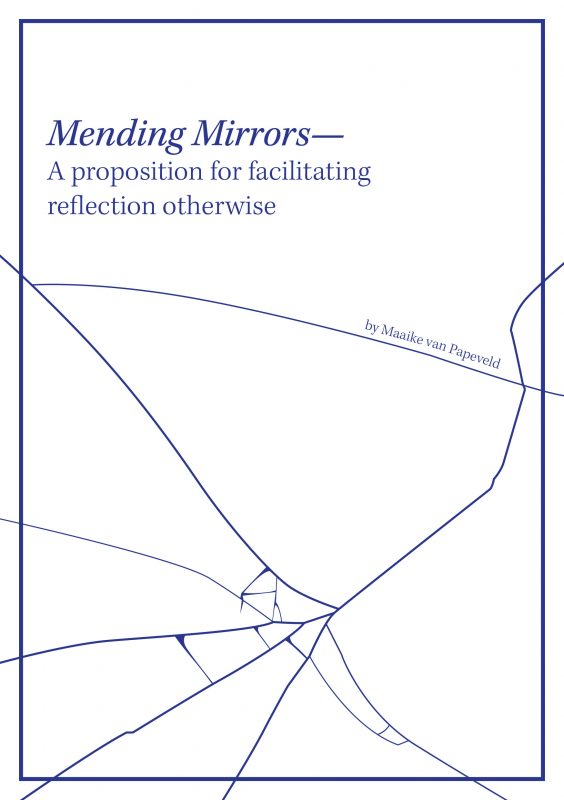
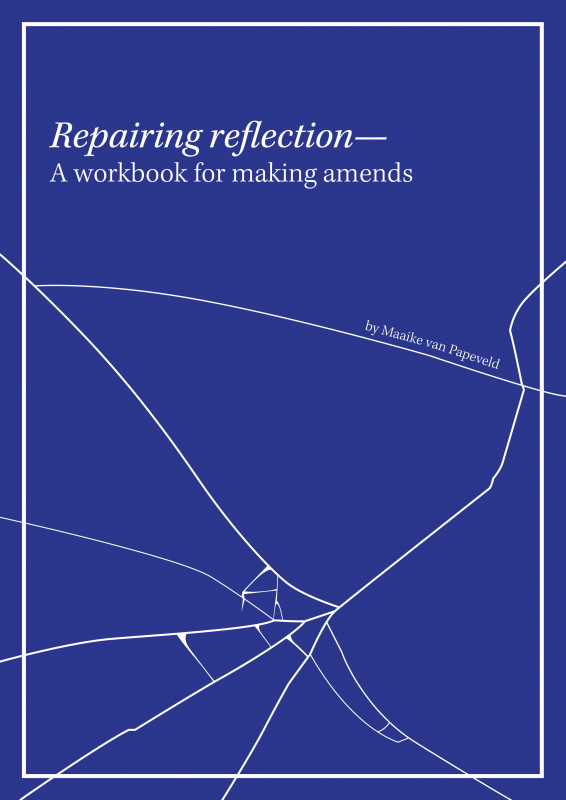
This research project aims to offer a starting point for doing so. In Mending Mirrors: A proposition for facilitating reflection otherwise, I revisit the theoretical foundations of reflection in a reparative way and elaborate a series of cracks – or pitfalls – that I observed in my teaching practice. The accompanying workbook, Repairing Reflection: A workbook for making amends, poses questions and offers perspectives on how reflection might be repaired and invites colleague educators to consider how they might do so in their own practice. I see the workbook as a first step toward the development of a series of resources for teachers and students, and – above all – as a conversation starter that will hopefully prompt many fruitful discussions.
Thesis: